
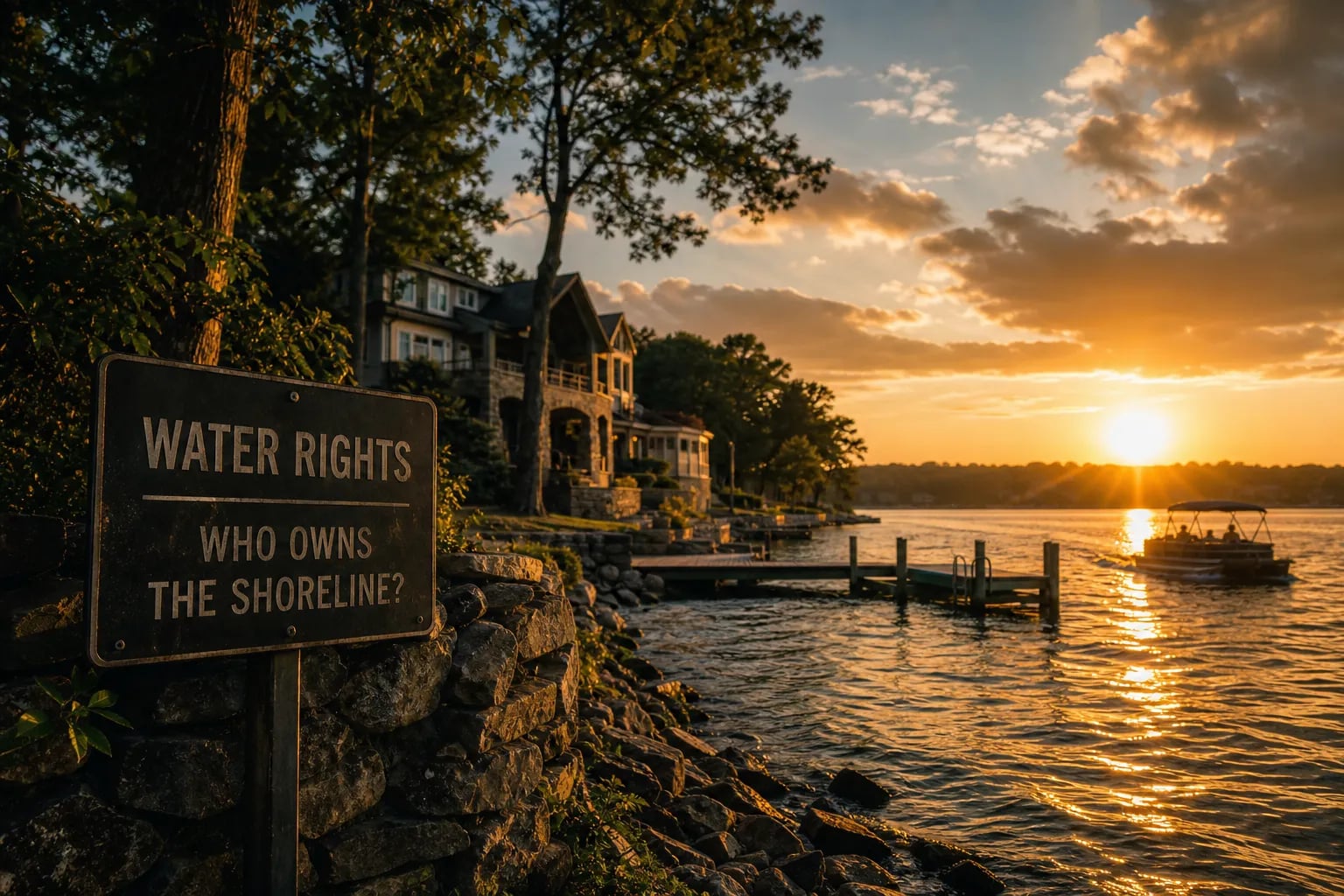
Lake Norman water rights are frequently misunderstood by buyers who assume that a waterfront purchase includes the house, the yard, and the lake in front of it. That assumption is understandable, but it’s wrong in ways that can cost real money. Lake Norman isn’t a natural lake governed by standard North Carolina property law. It’s a Duke Energy-managed reservoir built on a private easement system, and the rules governing docks, water access, and shoreline rights reflect that history in ways that don’t show up in a listing description.
When Cowans Ford Dam was built and the lake began filling in 1963, it flooded private farmland along the Catawba River. Duke Power secured flowage easements from those original landowners in 1961, before a single acre was submerged. Those easements gave Duke “absolute water rights” over what would become the lake bed. That foundational fact shapes everything else about how water rights at Lake Norman work today. Reviewing the shoreline classification, the permit history on any existing dock, and the HOA’s actual water access terms is standard practice at Carolina Realty Advisors before a client moves forward on any waterfront listing, because what’s in the deed and what a buyer pictures as “lake access” can be two very different things.
Lake Norman water rights and Duke Energy’s controlling easement
On naturally occurring lakes in North Carolina, the public trust doctrine generally places the submerged land in state ownership for the benefit of the public. Lake Norman doesn’t work that way. Because the lake was created by flooding private land under a private easement arrangement, Duke Energy, not the State of North Carolina, holds the controlling interest in the lake bed through those original flowage easements. The submerged land isn’t public trust property in the conventional sense. It’s private easement territory, and Duke’s authority over it is broad.
When you buy a Lake Norman waterfront lot, your property line typically runs to the shoreline at full pond elevation, not through the water. The ground beneath the lake surface falls under Duke’s flowage easement, which means Duke controls what can be placed, built, or modified there. The Catawba-Wateree water rights framework gives Duke authority over the reservoir surface, the lake bed, and the adjacent flood easement zone. This isn’t a technicality. It’s the legal baseline that every dock permit, shoreline structure, and water access dispute flows from.
What riparian rights actually give you as a shoreline owner
North Carolina recognizes riparian rights (for rivers and streams) and littoral rights (for lakes) as property rights that attach to land bordering a waterbody and pass with the deed without being separately listed. For a Lake Norman shoreline owner, these rights generally include:
- The right to access the water from your upland parcel
- A qualified right to build a dock or pier toward the water
- The right to make reasonable use of the water without unreasonably interfering with your neighbors
These are real and meaningful rights. They are not, however, ownership of the water or the submerged land beneath it.
The critical limitation is that Lake Norman riparian rights don’t override Duke’s easement authority or state regulatory requirements. The state can regulate dock and pier structures to protect navigation and public interests. Duke’s shoreline management rules layer additional requirements on top of that.
A shoreline property owner has rights of access and use, but those rights are exercised within a permit and approval system controlled by Duke and the relevant county. Skipping that process isn’t a shortcut. It can result in forced removal of unpermitted structures at the owner’s expense, and Duke can refuse future lake-use permits to owners who don’t comply.
Deeded water access and direct riparian ownership are not the same thing
Not every Lake Norman home that markets itself as “waterfront” or “water access” sits directly on the shoreline. Many subdivisions are set back from the lake and offer HOA-controlled access through a shared boat ramp, a community dock, or a designated shoreline easement. When a listing says “deeded water access,” that phrase can mean your own private dock on your own shoreline lot, a shared slip in a community facility, or simply the right to walk to the water through a common area. These are not equivalent. The difference directly affects how and when you can use the lake, what you can build, and what the property is actually worth.
Community dock arrangements come with their own layer of rules, and those rules are often invisible in the MLS listing. HOA agreements may include slip assignment policies, waitlists, maintenance cost-sharing requirements, and usage restrictions. Some communities prevent individual lot owners from building private docks even when the lot technically fronts the water. Others restrict what can be kept or constructed on the shoreline through HOA covenants. Reviewing the HOA declaration, the recorded plat, and Duke’s shoreline classification for the specific property are all necessary steps before assuming a listing gives you the lake access you’re picturing. The documents control the outcome, not the photos.
How Lake Norman water rights affect dock permits and shoreline structures
Duke Energy manages all shoreline structures across Lake Norman through its Shoreline Management Plan and an online application system called the Lake Access Permit System, known as LAPS. Building a new dock, replacing an existing one, adding a boat lift, or doing significant shoreline work all require a Duke lake-use permit before any work begins. Duke’s shoreline classification for your specific property determines what is and isn’t allowed at that location. Some shoreline segments are designated for limited use or environmental protection, which means a dock may not be approvable regardless of what a seller’s agent says about the property’s potential.
The county permit layer on top of Duke approval
A Duke lake-use permit doesn’t replace county or local permits. Lake Norman touches four counties: Catawba, Iredell, Lincoln, and Mecklenburg. Each can require its own building permit, zoning review, floodplain permit, stormwater review, or electrical permit depending on the scope of work.
Projects involving dredging, wetland fill, or significant water impacts may also trigger review by the NC Division of Environmental Quality or the U.S. Army Corps of Engineers. The permit stack for a new dock can involve three or four separate approvals from different agencies, and that process takes real time and carries real cost. Buyers who believe they’re purchasing a “dockable lot” should verify the shoreline classification and permit history before closing, not after.
Lake levels change throughout the year and that affects your shoreline
Lake Norman’s water level is not a fixed number. Duke Energy actively manages releases through Cowans Ford Dam to serve the broader Catawba-Wateree hydroelectric system, and those levels move in a predictable seasonal pattern. Duke’s operational targets, as documented in NC DEQ planning records, generally run near 98% of full pond from June through August, drop slightly in September and October to the 97 to 98% range, and then fall further into the 92 to 94% range in February and March to preserve flood storage capacity. That seasonal drawdown can expose significant stretches of shoreline and leave shallow coves with minimal water depth during fall and winter.
Beyond the seasonal cycle, Duke can move into drought protocols that reduce levels further than the seasonal baseline. For properties in shallow coves or with naturally low bottom depth near the dock, these drawdown periods can make the dock functionally unusable for months at a time. A buyer who tours a property in July may be looking at a very different shoreline in February. Shallow water at the dock during drawdown season is a known characteristic of reservoir ownership at Lake Norman, not an unusual event. Properties that show well in summer photos sometimes catch buyers off guard when they haven’t asked about winter conditions.
What to verify before closing on a Lake Norman waterfront home
Before making an offer on a Lake Norman waterfront property, confirm several things directly rather than through the seller’s agent. Start by checking the property’s Duke shoreline classification to understand what’s permitted at that specific location. Then verify that any existing dock has an active, valid Duke lake-use permit in the current owner’s name. A dock permit tied to a previous owner’s name creates complications during and after a sale, and untangling it requires going back through the LAPS process, which takes time and doesn’t always produce the result buyers expect.
Review the property survey to confirm where the lot lines end and where Duke’s easement begins. If the property is part of an HOA community with shared water access, read the HOA covenants and the recorded plat carefully to understand what you can and can’t build or modify on the shoreline. These aren’t optional steps. They’re the difference between buying a waterfront home and buying a waterfront problem.
This is the standard approach at Carolina Realty Advisors on every Lake Norman waterfront transaction. Broker-owner Mike Sposato reviews the shoreline classification, the existing permit status on any dock, the HOA’s water access terms, and the plat records before a client moves forward. With 26 years and over 1,500 closings concentrated in this region, that experience produces a level of pattern recognition that matters: which shoreline classifications routinely result in permit denials, which communities have HOA access structures that don’t match buyer expectations, and what a dock permit in the wrong name actually costs to resolve. That’s the kind of evaluation that doesn’t happen on a showing and can’t be outsourced to an attorney after the fact.
Understanding Lake Norman water rights: the framework that matters
Lake Norman water rights follow a clear framework once you understand the history. Duke Energy holds the controlling easement over the lake bed, not the state or individual property owners. Riparian and littoral rights give shoreline owners meaningful but qualified use rights, not ownership of the water or submerged land. HOA-controlled water access is legally distinct from direct shoreline ownership, and the gap between those two things has real consequences for what you can build, how you access the lake, and what the property is worth over time. The permit system for docks and shoreline structures runs through Duke first, then the county, and potentially state and federal agencies depending on the scope of work.
None of this makes Lake Norman waterfront ownership impractical. Thousands of homeowners use this lake without issue every day. The risk comes from assuming the answer without checking the details first. If you’re considering a Lake Norman waterfront purchase, reach out to Carolina Realty Advisors before you make any decisions. The conversation is free. The surprises after closing are not.
Frequently asked questions about Lake Norman water rights
Who owns the water and lake bed at Lake Norman?
Duke Energy holds the controlling interest in the Lake Norman lake bed through flowage easements secured before the reservoir was filled in 1963. Unlike naturally occurring lakes where the state typically holds submerged land under the public trust doctrine, Lake Norman’s bed is private easement territory. Individual property owners do not own the water or the ground beneath it.
Do Lake Norman waterfront property owners have riparian rights?
Yes. Shoreline owners hold riparian or littoral rights that attach to the land and pass with the deed. These rights include access to the water, a qualified right to build a dock, and the right to make reasonable use of the water. Those rights are real, but they are exercised within Duke Energy’s permit system and applicable county regulations, they don’t override either.
What permits are required to build a dock on Lake Norman?
Any new dock, boat lift, or significant shoreline structure requires a Duke Energy lake-use permit obtained through the LAPS system before work begins. Beyond that, one or more county permits may be required depending on the county and scope of work. Larger projects may also require NC DEQ or U.S. Army Corps of Engineers review. The permit stack often involves three or four agencies.
What does “deeded water access” mean on a Lake Norman listing?
The phrase can mean several different things: a private dock on a direct shoreline lot, a shared slip in a community dock facility, or simply the right to reach the water through a common area. These are not equivalent in terms of use rights, buildability, or property value. Always review the HOA declaration, the recorded plat, and the Duke shoreline classification before assuming what a listing’s water access actually includes.
How does Lake Norman’s seasonal water level affect property owners?
Duke Energy manages the reservoir to serve the broader Catawba-Wateree hydroelectric system. Levels typically run near full pond in summer and drop into the 92 to 94% range in late winter to preserve flood storage capacity. Properties in shallow coves can see docks become unusable during drawdown periods. This is a predictable, recurring characteristic of reservoir ownership at Lake Norman, not an exception.
What should I verify before closing on a Lake Norman waterfront home?
Confirm the Duke shoreline classification for the specific property, verify that any existing dock permit is active and in the current owner’s name, review the property survey for lot line and easement boundaries, and read the HOA covenants and recorded plat if the property involves shared water access. These steps should happen before an offer is finalized, not after closing.