
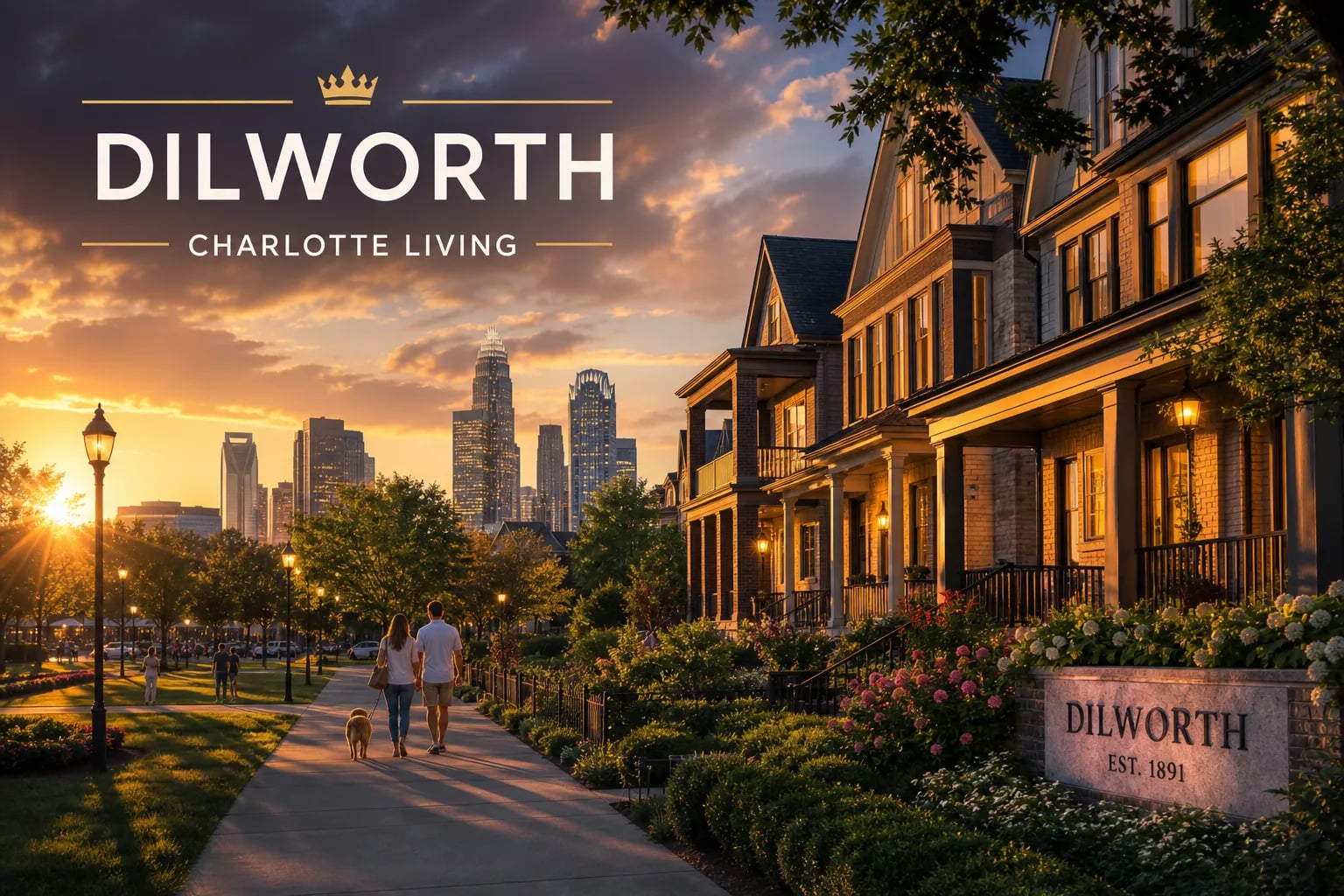
Picture East Boulevard on a Tuesday morning: mature oaks arching over sidewalks, a Craftsman bungalow with its original porch columns sitting next to a sleek three-story infill build, and a coffee shop two blocks away that’s been there long enough to know the regulars by order. Dilworth Charlotte homes sit just 2.1 miles from Uptown, but the neighborhood operates at a completely different pace. Many local agents consider it one of the most sought-after neighborhoods in the city, and it’s also one of the most unforgiving places to buy if you don’t know what you’re actually looking at.
The challenge isn’t finding Dilworth real estate. The challenge is evaluating it. A listing photo can show gorgeous hardwood floors and a renovated kitchen without revealing a 1950s electrical panel, original galvanized supply lines, or a crawl space that hasn’t been addressed since the 1990s. Buyers who succeed here don’t just browse listings; they know how to read a home. That kind of pattern recognition, built from hundreds of closings in these exact neighborhoods, is what separates a good purchase from an expensive lesson.
This guide covers everything you need to navigate the 2026 Dilworth market: the actual housing stock, what your budget buys at each price tier, the lifestyle trade-offs no listing will mention, and a five-step plan to move from search to signed contract with your eyes open.
Dilworth Charlotte Homes: Styles and Housing Stock
Most buyers arrive in Dilworth with a mental image of a shaded street lined with Craftsman bungalows. That image is accurate. It’s just not the whole picture.
Craftsman bungalows, colonial revivals, and the historic core
Dilworth’s identity is anchored in homes built between roughly 1895 and 1960, with Craftsman bungalows, bungalow-colonials, and some Victorian-era structures making up the majority of the single-family stock. Typical sizes land between 2,300 and 2,600 square feet on lots that run from about 0.1 to 0.3 acres. These homes have genuine character: original hardwoods, front porches, detailed millwork, and a sense of permanence that new construction can approximate but rarely replicate.
That character comes with age-related realities. Homes in this era regularly carry inspection findings around crawl space moisture, outdated electrical systems (knob-and-tube wiring and undersized panels are still out there), aging plumbing, and wood rot around windows and trim. None of those findings are automatic deal-killers, but knowing which ones represent negotiation leverage and which ones represent a reason to walk is a skill, not a search filter.
Infill builds, townhomes, and condos: the newer layer
Dilworth isn’t frozen in 1920. New infill builds and townhomes have filled in gaps throughout the neighborhood, and Dilworth condos and bungalows together round out the full range of available housing types. Condo units typically run from about 769 square feet for a one-bedroom to 1,150 square feet for a two-bedroom, with HOA fees generally falling between $300 and $450 per month in 2026 based on current listing data. Townhomes average around 1,800 square feet and carry HOAs in the $200 to $400 range.
These newer homes attract a specific buyer: someone who wants Dilworth’s location, walkability, and neighborhood identity without the maintenance envelope of a century-old structure. If your priority is low upkeep in a strong location, attached housing in Dilworth is a legitimate path. If your priority is a front porch and original character, you’re in historic single-family territory, and the evaluation criteria shift significantly.
2026 Price Reality: What Your Budget Actually Buys in Dilworth Charlotte
Dilworth price data varies depending on the source and the metric. The numbers vary depending on which platform you check and which sales window they’re measuring, here’s what they actually mean in practice.
Entry-level to mid-range: condos and smaller bungalows under $700K
The entry point for Dilworth real estate sits around $400,000 to $450,000 for smaller attached homes, condos, and the occasional original bungalow that needs meaningful work. The mid-range, roughly $500K to $700K, typically yields a renovated smaller single-family home or a quality townhome. Realtor.com’s neighborhood-level data reports a median sale price of approximately $443,500 with 1.95% year-over-year growth (as of mid-2026), while Redfin’s three-month data ending June 2026 puts the median sale price at $975,000. Both numbers are real; they’re measuring different slices of the same market.
The spread reflects Dilworth’s wide inventory mix. When you average condos, townhomes, and historic estates together, the median shifts dramatically depending on what sold in a given window. For buyers in the $500K to $700K range, the realistic expectation is a well-located attached home or a smaller single-family property that may need some updating on the mechanical side.
The $700K to $1.5M+ tier: renovated historic homes and premium new builds
Buyers in this bracket are purchasing fully renovated or new-construction homes in the 2,300-plus square foot range, often on the better blocks near Freedom Park or the East Boulevard corridor. The spread within this tier is wide and heavily influenced by renovation quality, which is the single most important variable in Dilworth’s historic stock and the topic the next section covers in full detail.
Current inventory context: roughly 40 to 68 active Dilworth NC listings exist depending on the data source (Realtor.com’s neighborhood page shows approximately 57 active listings with a median of 82 days on market; a broader Realtor.com search pulls closer to 68 active listings at 48 days on market), with for-sale inventory up about 22.5% year-over-year. That means buyers in 2026 have more options than they did twelve months ago. The market has softened slightly but not stalled. With inventory up 22.5% year-over-year and days on market extended compared to recent peaks, prepared buyers with clear criteria are in a stronger position than they’ve been in some time.
Walkability, commute, and the real Dilworth lifestyle
Buyers don’t choose Dilworth primarily for square footage. They choose it for how daily life actually feels. Here’s what the data backs up.
Walk Score, transit, and getting around without a car
Dilworth carries a Walk Score of 78 to 81 depending on the specific address, solidly walkable by Charlotte standards, where most suburban neighborhoods score in the 20s and 30s. Practically, that means coffee shops, restaurants on East Boulevard, Freedom Park, and basic errands are accessible on foot from most of the neighborhood. The LYNX Blue Line and CityLYNX Gold Line stops are nearby for car-free commuters, though transit usefulness varies by block; buyers who rely on rail access should check specific stop proximity for any address they’re considering.
Commuting to Uptown and beyond
Dilworth sits 2.1 miles from Uptown Charlotte, with car commute times running 7 to 12 minutes. For buyers whose priority is proximity to the urban core without paying Uptown condo prices, this is one of the strongest value propositions in the Charlotte market. I-77 access is nearby for buyers who commute south toward Fort Mill or Rock Hill, and the neighborhood’s central position makes it workable across a range of professional schedules.
Renovated vs. flipped: the most important question a Dilworth buyer must ask
This is where a surface-level neighborhood guide ends and real advisory begins. In Dilworth’s historic housing stock, the gap between a genuine renovation and a cosmetic flip can represent a substantial difference in actual value, often reflected in future repair costs that don’t show up in the list price. Most buyers can’t tell the difference from listing photos, and many can’t tell from a first showing, either.
What a quality renovation actually looks like
A well-renovated historic home in Dilworth shows its work: permits pulled and closed for electrical, plumbing, structural changes, and HVAC upgrades. The mechanical systems, not just the cosmetic surfaces, have been addressed. HVAC has been replaced, not patched. Electrical panels have been upgraded from the original undersized or knob-and-tube configurations. Plumbing supply lines are copper or PEX, not galvanized. Period details are preserved or restored rather than ripped out for a generic open-concept layout. A genuine renovation adds value that holds; a cosmetic one borrows against future repair costs.
The red flags that signal a flip
Fresh paint is not a renovation. Neither are new light fixtures, staged furniture, or recessed lighting that conveniently covers what used to be a ceiling stain. Experienced buyers learn to spot inspection-level signals that less prepared buyers miss:
- New finishes paired with original galvanized supply lines
- Brand-new kitchen cabinets alongside an untouched 60-amp electrical panel
- Tight staging that draws the eye away from the mechanical room
- Uneven paint lines or sloppy trim that reveal a rushed timeline
Asking for a permit history and comparing it against what you can see during a tour is the fastest practical test. If the house shows a beautiful kitchen but no permit record for electrical or plumbing, you’re likely looking at a cosmetic flip.
Why pattern recognition is the edge you need in Dilworth
After 26 years and more than 1,500 closings in Charlotte’s urban neighborhoods, experience Mike Sposato at Carolina Realty Advisors has built working specifically in this market, he has walked through enough Dilworth Charlotte homes to know the difference between a $40,000 mechanical overhaul and a $12,000 paint-and-fixture job presented the same way on Zillow. That trained eye, knowing when an inspection finding is a negotiation lever versus a reason to walk, is what actually protects buyers in a neighborhood where emotion runs high and prices leave little margin for surprises. No app replicates it.
A 5-step action plan for buying Dilworth Charlotte homes in 2026
Understanding the market is step one. Moving through it with a structured plan is what actually gets you to a signed contract on the right property.
Steps 1 and 2: Define your criteria and get pre-approved with specifics
Step 1 is narrowing your home type and price band based on everything covered above. Are you a bungalow buyer, a townhome buyer, or open to new infill? Your answer changes which blocks you target, which inspection findings matter most, and how you construct a competitive offer. Step 2 is securing a fully underwritten pre-approval, not just a pre-qualification letter. In a market where some Dilworth homes still move quickly when priced correctly, showing up with a conditional pre-qualification puts you at a real disadvantage against buyers who did the work upfront.
Steps 3, 4, and 5: Search intentionally, tour critically, and offer strategically
Step 3 is setting Dilworth MLS alerts tuned specifically to this neighborhood, not the broader “South Charlotte” or “Midtown” filters that pull in unrelated inventory and create noise. Step 4 is touring with the renovated-vs.-flipped framework actively in mind: ask about permits, mechanical ages, and renovation timelines during every showing, not just when something looks suspicious. Step 5 is constructing a competitive offer that accounts for the current 48-to-82-day market data and a clear inspection contingency strategy. Hitting list price and hoping is not an offer strategy; it’s a coin flip.
The honest trade-offs of Dilworth living
Every neighborhood has a flip side, and buyers who understand it before they move in make better decisions than those who discover it after.
Schools, amenities, and what Dilworth actually delivers
Dilworth has Freedom Park, a strong restaurant and retail corridor on East Boulevard, and proximity to South End’s breweries and the light rail. On the school side, CMS assigns students by exact street address, not neighborhood name. Dilworth Elementary serves the area with a split campus structure (PK-2 at the main campus, grades 3-5 at the Latta Campus), and middle school assignments feed into the Sedgefield area. Because school assignments can shift with CMS boundary updates, buyers with school-age children should verify their specific address through the CMS school locator before making a purchase decision. The private school market is active in this part of Charlotte for that reason.
Parking, lot size, and the trade-off worth knowing
Dilworth lots typically run small (0.1 to 0.3 acres), and many historic homes have one-car garages or street-only parking. For buyers relocating from suburban markets with three-car garages and wide driveways, this is a genuine lifestyle adjustment. It surfaces after move-in when it hasn’t been part of the buying decision, and it’s worth addressing directly before you fall in love with a particular bungalow.
The reframe is this: you’re not buying square footage and storage in Dilworth. You’re buying proximity, walkability, and a neighborhood with a real identity built over more than a century. In the Charlotte market, that holds value in ways that a newer suburban neighborhood with a larger lot cannot match. The buyers who thrive here understand that trade-off and make it intentionally.
Ready to start your search for Dilworth Charlotte homes?
Dilworth is one of Charlotte’s most compelling urban neighborhoods, with a housing stock that rewards buyers who know how to evaluate what they’re looking at. The 2026 market shows steady prices and a meaningful inventory increase, giving prepared buyers more options than they’ve had in recent years. But more inventory doesn’t protect you from overpaying for a cosmetic flip on a 1950s electrical panel. Knowing your price band, understanding the difference between a renovated and a flipped historic home, and moving through the process with a clear plan are what separate buyers who land the right property from those who learn expensive lessons.
Carolina Realty Advisors works specifically in Dilworth and the surrounding Charlotte urban core, with the closing history in these exact neighborhoods to back up every recommendation. Mike Sposato handles every transaction personally, no team handoffs, bringing the kind of trained eye that comes from 26 years and more than 1,500 closings concentrated in this region. If you’re ready to look at Dilworth Charlotte homes for sale with someone who knows the difference between the good blocks and the good-looking listings, reach out to Mike directly for a no-pressure conversation about where your criteria fit in the current market.