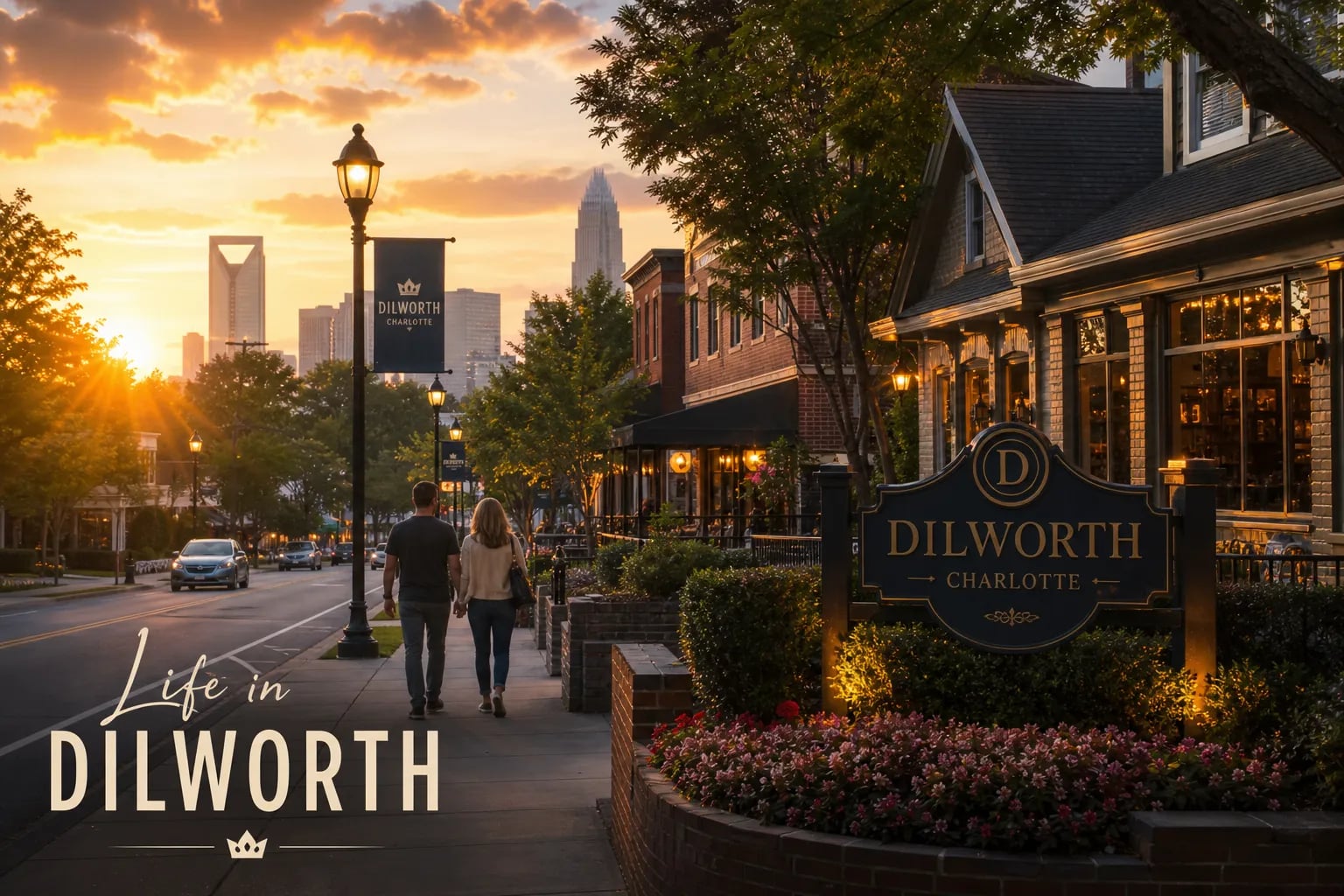
Picture a Tuesday morning in Dilworth. You walk out of a 1920s craftsman bungalow, coffee still brewing inside, and cut down a shaded sidewalk on East Boulevard. Eight minutes later, you’re at your desk in Uptown. No highway, no parking garage, no stress. That’s not a real estate pitch. That’s what a typical weekday actually looks like for people who live here.
Dilworth Charlotte living rewards buyers who understand it at the block level. After helping dozens of professionals find a home in this neighborhood, not just in this zip code, a few truths stand out every time. It has real trade-offs worth knowing before you tour. And it delivers a daily quality of life that’s genuinely hard to replicate anywhere else in Charlotte. This article covers all of it: what the housing stock looks like, what things cost, how the commute actually behaves, which schools serve the area, what the safety data says, and why the street you choose inside Dilworth matters more than most buyers expect.
The housing character that makes Dilworth unlike most Charlotte neighborhoods
What the streets and homes actually look like
Dilworth is one of Charlotte’s earliest streetcar suburbs, with most of its development concentrated between the 1920s and 1940s, and that history is visible in every block. Craftsman bungalows, colonial revivals, and Dutch colonials line a tight residential grid, most of them shaded by mature trees that took decades to grow. The neighborhood doesn’t look like a subdivision because it isn’t one. The architectural consistency here is the product of a specific era of construction, not a master-planned aesthetic.
Parts of Dilworth fall under Charlotte’s Historic District Overlay, which means exterior changes require a Certificate of Appropriateness from the Historic District Commission before any permits can be pulled. That process covers additions, fences, rooflines, windows, and visible facade work. For buyers planning a major renovation or addition, this distinction is critical and worth confirming before closing. Outside the overlay, more flexibility exists, but the neighborhood’s character still rewards renovations that respect the original style.
What it costs to buy or rent in Dilworth Charlotte right now
The median closed sale price in Dilworth sits at approximately $975,000 based on Redfin’s most recent data through mid-2026. Entry-level bungalows in need of updating can still come in below that median, while renovated or historic-certified homes can sell for well above it, in some cases reaching the low millions for fully updated properties on desirable streets, based on recent MLS closed sales.
For professionals not ready to buy, the rental market offers a real entry point. Median rent in Dilworth runs around $2,402 per month for apartments and smaller rentals, which isn’t cheap, but it allows someone to live inside the neighborhood and understand it at ground level before committing to a purchase. Renting in Dilworth first is a legitimate strategy. Local agents consistently note that the block-level differences that matter for buying become obvious once you’ve actually walked the streets for six months.
Dilworth Charlotte living: morning routines and what walkability actually means here
Coffee, breakfast, and the East Boulevard rhythm
Dilworth carries a Walk Score of 78, placing it firmly in the “Very Walkable” category, but that number undersells the practical reality. Most of your weekday errands happen within a 10-minute walk. Grocery runs, coffee, dry cleaning, dinner reservations: all of it is reachable without unlocking your car. For people coming from suburban Charlotte or relocating from denser cities, Dilworth walkability hits a specific sweet spot that’s hard to find elsewhere in the metro.
On a weekday morning, the East Boulevard Dilworth corridor is the neighborhood’s social spine. Not Just Coffee, Dilworth Coffee, Sunflour Baking Company, and Crema Espresso Bar all draw a consistent crowd of residents who walk there and walk back. The rhythm feels genuinely local, not manufactured, the kind that develops when people have been coming to the same places for years. Latta Park sits at the heart of the neighborhood and provides a quiet morning walk option before the day starts. By 8 a.m., the sidewalks are busy with foot traffic.
The dining and bar scene beyond East Boulevard
The restaurants in Dilworth aren’t just dining options, they’re where neighbors actually see each other. Copper holds a 4.8 out of 5 on OpenTable and books up regularly for good reason. Kid Cashew draws a consistent crowd for Mediterranean small plates and patio seating. Dressler’s handles upscale dinners. The Dilworth Tasting Room and Foxcroft Wine Co. serve as casual weeknight anchors where “just stopping in for one glass” reliably turns into two hours. These aren’t spots you go to on special occasions once you live here; they become part of your weekly pattern. 300 East is one of the neighborhood’s longest-standing restaurants, serving contemporary American comfort food and a brunch menu that draws regulars from across Charlotte.
The density of quality options within walking distance is one of Dilworth’s clearest daily advantages for residents, a distinction that stands out when you compare Walk Scores and restaurant counts against other Charlotte neighborhoods in the same price range.
Commute reality from Dilworth to everywhere you need to be
Getting to Uptown: what 5 to 10 minutes looks like in practice
From most Dilworth blocks, Uptown Charlotte is a 5 to 10 minute drive. That estimate holds during typical rush hours: the route doesn’t require highway access, so you’re on surface streets the whole way, with multiple options if one corridor backs up. For working professionals, this commute is genuinely different from anything suburban. You’re not losing 45 minutes each way; you’re losing 8.
For non-drivers, the Blue Line light rail’s East/West Blvd Station serves the neighborhood and opens up direct access to Uptown, South End, and the University City corridor without a car. CATS Route 19 (Park Road) also runs through the neighborhood. The transit infrastructure here isn’t as robust as a major metro system, but it gives car-free residents real options that most Charlotte neighborhoods don’t offer.
What the commute means when choosing your specific block
Dilworth is not uniform in commute terms. Streets closer to East Boulevard and the South End edge have faster access to main arteries and the Blue Line. Streets deeper into the interior of the neighborhood trade a minute or two of commute speed for quieter residential character and more separation from commercial corridors. Neither trade-off is wrong, it depends on what you’re optimizing for. But understanding it before you make an offer matters.
This block-level variation runs through every aspect of living in Dilworth, Charlotte. The zip code gets you into the neighborhood; the specific street determines what daily life actually feels like. That distinction is worth keeping in mind throughout your search.
Schools, safety context, and what families evaluating Dilworth should know
The school picture for Dilworth residents
Dilworth Elementary’s Latta Campus holds an A- from Niche and an 8 out of 10 on GreatSchools, a solid public elementary option for a walkable urban neighborhood. Myers Park High School is A-rated and consistently ranks among Charlotte’s stronger public high schools. Sedgefield Middle School sits one mile from the neighborhood. Taken together, the public schools serving Dilworth have solid ratings across all three levels, without requiring a private school to fill a gap.
That said, many buyers purchasing in the $1M-plus range in Dilworth also factor in access to Charlotte’s private school options, which are strong and located within a short drive. The public school baseline here is better than most people expect from an urban neighborhood, but it isn’t perfect. Families with specific educational priorities should verify current enrollment boundaries and program offerings directly with Charlotte-Mecklenburg Schools before making decisions.
Understanding the safety data without overstating it
The direct answer: Dilworth’s reported crime rate runs above the Charlotte city average in most datasets, driven largely by property crime, larceny and vehicle theft, though some sources report elevated violent-crime indices as well. According to data from CrimeGrade and Areavibes, one dataset places Dilworth’s overall crime index at 156 versus Charlotte’s 115, and another reports roughly 59 crimes per 1,000 residents annually, with property crime making up the large majority of that figure.
Context matters here. Dilworth is a dense, walkable, retail-active neighborhood adjacent to Uptown. Statistically, that combination, foot traffic, commercial activity, parked cars on busy corridors, produces higher reported incident counts than a car-dependent suburb where most activity happens inside private property. The block you’re on matters significantly: streets near commercial corridors see more incidents than residential side streets closer to Freedom Park. This is precisely the kind of nuance that a zip code search doesn’t surface and a hyper-local broker should walk you through directly.
The community rhythm and who actually lives in Dilworth
Events, parks, and how neighbors actually connect
Freedom Park anchors Dilworth’s western edge and functions as one of Charlotte’s most-used green spaces. Weekend mornings there feel like a neighborhood gathering, dog walkers, joggers, families, and regulars who’ve been coming for years. The park gives the neighborhood a genuine social infrastructure that goes well beyond having a coffee shop nearby. It’s a place where people actually run into each other.
The Dilworth Community Association runs a consistent annual calendar that includes the Dilworth Jubilee (a free family festival in Latta Park with live music, food trucks, and a pet parade, most recently held in May), the Dilworth Home Tour in September, and several seasonal events throughout the year. These aren’t poorly attended HOA meetings, they draw real neighborhood participation. The result is a community where longtime residents and newer arrivals interact around shared neighborhood identity rather than just shared real estate.
The demographic mix and lifestyle fit
Based on local broker observations and neighborhood profiles, Dilworth tends to draw working professionals in their 30s and 40s, established families who built equity before the recent price run-up, and a smaller but consistent number of retirees who want walkability without leaving Charlotte proper. At current prices, this is not a starter-home neighborhood, the buyer pool skews toward dual-income households or equity-rich move-up buyers who know what they’re trading for. The entry bar is real.
Many professionals relocating from Washington D.C., Atlanta, Boston, or Chicago report that Dilworth is the most immediately familiar neighborhood in Charlotte. It has urban texture, sidewalks with actual foot traffic, restaurants within walking distance, and a transit option, without the high-rise density of Uptown or the car-dependent sameness of the suburbs. For people accustomed to neighborhood-level identity in a larger city, Dilworth Charlotte living translates well.
Why your specific street in Dilworth matters more than the zip code
What hyper-local expertise actually changes for a buyer
The difference between a good Dilworth purchase and a great one consistently comes down to the block. Proximity to Freedom Park is widely regarded by local agents as a strong positive for resale. Streets inside the Dilworth historic district overlay come with renovation constraints that some buyers don’t fully understand until after closing, when they discover that adding a dormer or changing windows requires HDC approval. Infill construction on certain streets has visibly changed the character of blocks that looked purely residential just a few years ago, a trend local brokers have tracked through recent permitting activity. None of this is visible from an MLS search or an automated valuation tool.
A regional or out-of-area agent can get you a showing in Dilworth. A hyper-local broker tells you which blocks hold value through market cycles, what an inspection finding in a 1930s bungalow actually signals versus what can be negotiated, and which streets carry hidden constraints that won’t show up until due diligence. The zip code gets you to the neighborhood. The right counsel gets you to the right street within it.
How Carolina Realty Advisors approaches Dilworth Charlotte living for relocating buyers
Carolina Realty Advisors has worked with professionals relocating to Charlotte specifically into Dilworth’s established corridors, not because it’s a popular search category, but because the neighborhood’s block-level dynamics reward exactly the kind of pattern recognition that only comes from years of actual closings in the area. Broker-owner Mike Sposato handles every transaction personally. That means a buyer relocating from out of state gets direct counsel on which streets to prioritize, what an inspection finding actually signals versus what can be negotiated, and how to write an offer that reflects real neighborhood comps rather than automated estimates that don’t account for street-level differences.
The goal isn’t just finding a house in Dilworth, it’s landing on the right street, with full confidence in what you’re buying and what that block is likely to look like five years from now. That level of specificity only comes from working with someone who has closed transactions throughout the neighborhood across different market cycles and knows how to read what’s actually in front of you.
If you’re evaluating Dilworth Charlotte living or want to understand how it compares to nearby Charlotte neighborhoods before you start touring, reach out to Carolina Realty Advisors for a no-pressure conversation. The aim is to give you a clear picture before you set foot in a single open house.