
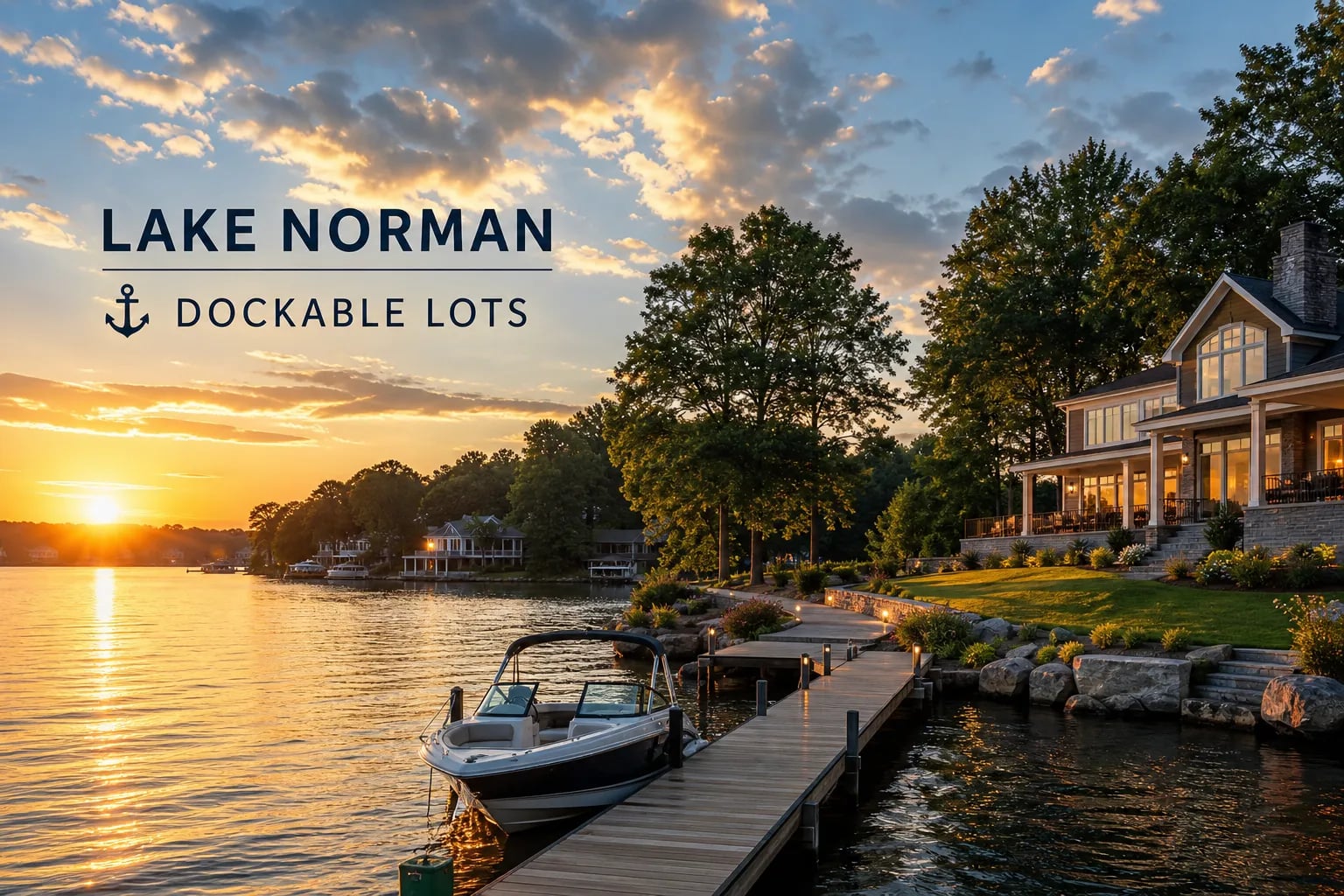
If you’re searching for dockable lots on Lake Norman, you’ll hit the same wall every waterfront buyer encounters. The listing says “waterfront,” the photos show a gorgeous shoreline, and the price reflects a premium that only makes sense if a private dock is part of the deal. Then comes the discovery: waterfront and dockable are not the same thing on Lake Norman. Confusing those two terms can mean months of untangling permits after closing, or costly remediation that no buyer anticipates when they fall in love with a property.
This distinction matters enough that Mike Sposato at Carolina Realty Advisors makes it a first-conversation topic with every Lake Norman waterfront buyer he works with. In over two decades of closings on the lake, the dock permit complications he has seen range from permits still in prior owners’ names to structures built outside approved footprints, and lots that looked dockable on paper until the Duke Energy shoreline classification told a different story. This guide covers the five things you need to understand before making an offer on any lot marketed as dockable: what dockability actually requires, where to find genuine inventory, how to verify dock rights in the deed and title, what Duke Energy’s permit process looks like, and how HOA covenants can quietly override everything else.
What “Dockable” Actually Means on Lake Norman
Not every lot with shoreline footage qualifies for a private dock, and the listing term “dockable” carries no legal definition that protects you. Riparian rights, the legal right to use the water adjacent to your land, attach to property through the deed. But having riparian rights does not automatically mean you can build a private dock. Some waterfront parcels share access rights with neighboring parcels or a community common area rather than granting exclusive individual rights. Others border the lake physically but lack deeded riparian access entirely.
Duke Energy controls Lake Norman’s shoreline and classifies every parcel into use categories through its Shoreline Management Plan. Only parcels classified as Residential or Future Residential qualify for private dock structures. A Residential Marina classification means shared dock access, not a private one. An Environmental classification prohibits dock construction entirely. A lot can have legitimate riparian rights in the deed and still sit in a classification that makes a private dock impossible.
Even when the classification and deed language check out, physical thresholds apply. Duke’s guidelines require at least 100 linear feet of developable shoreline, with an older exception for pre-September 2006 parcels that may qualify at 75 feet. A common design guideline targets roughly 10 feet of water depth at the dock’s outer end, though Duke evaluates each site individually and can deny a permit if the outer end would sit in very shallow water, so confirming site-specific depth with Duke before you contract is essential. Structures also need to observe a 50-foot buffer from the 760-foot full-pond elevation line. These are Duke Energy placement guidelines, not county ordinances, which means they control the permit decision in ways most buyers don’t anticipate until after they’ve fallen in love with a property.
Finding Dockable Lots on Lake Norman: Where to Search
MLS listing language for waterfront land on Lake Norman varies widely in what it actually signals. “Existing dock” and “dockable lot” are not interchangeable. An existing dock with a valid, transferable Duke Energy permit is a meaningfully different asset than a listing that says “dockable” without any structure or permit documentation attached. “Grandfathered boat ramp,” “covered 2-slip boathouse,” and “dock and pier” each imply a different level of due diligence ahead of you. The follow-up questions to ask on any of these listings: Is there a current Duke Energy permit? Is it in the current owner’s name? Has it been modified since it was issued?
Active inventory on the lake currently ranges considerably by area and price point. A one-acre lot in Catawba with a covered 2-slip dock sits around $350,000. A 0.64-acre lot in Terrell with 122 feet of frontage and a private dock in place is priced at $549,900. Mid-range lots with dock or pier features cluster between $450,000 and $1.2 million across Terrell and Catawba County, while premium parcels in Sherrills Ford and upper Terrell push well above $3 million. These are starting points for calibration, not a complete picture of available inventory. New lots come on and off the market regularly, and desirable dockable parcels often sell quickly in competitive price bands.
Geography matters here. Lake Norman spans Mecklenburg, Iredell, Catawba, and Lincoln counties. Cornelius and Davidson are largely built out with limited raw land remaining. Mooresville, Terrell, Sherrills Ford, and the Catawba side tend to carry more available dockable lots. Community type also shapes the search: private-dock communities, shared-access communities, and lake-access-only subdivisions all exist within the same zip codes, and distinguishing between them at the search stage saves significant time.
Verifying Dockable Lots on Lake Norman: Deed, Title, and Survey Checks
The deed is the first document to pull, and it’s the foundation of everything else. Look for explicit language granting riparian rights, shoreline access, or dock rights. The recorded plat will show whether the lot boundary actually reaches the waterline, the foundational requirement for private riparian rights. Some waterfront parcels have this language clearly stated; others don’t, and the absence matters.
Order a title commitment as early as possible in due diligence. Title searches surface easements, shared access arrangements, deed restrictions, and encumbrances that aren’t visible from a street view or a listing photo. A dock that looks entirely private may be shared under an easement recorded thirty years ago. Working with a title attorney who has Lake Norman waterfront experience is strongly recommended on these transactions, missed recorded restrictions or unresolved encumbrances carry consequences that a generalist review may not catch.
A boundary and riparian survey goes a step further: it shows exactly where your lateral lines project into the water, identifies encroachments, and confirms whether the lot’s shoreline is unobstructed. If an existing dock is already on the property, ask for the current Duke Energy permit and confirm whether it is transferable at closing. A permit in a prior owner’s name, or one that has lapsed, can require months and significant expense to resolve. Asking before the offer costs nothing. Discovering the problem after closing is a different matter entirely.
Duke Energy’s Permit Process and Why It Controls Everything
Most buyers expect the county to be the primary approval authority for dock construction. On Lake Norman, Duke Energy Lake Services is the starting point for any dock, pier, boat lift, boathouse, or shoreline structure. New builds, replacements, expansions, and most modifications all require Duke approval before any construction begins. The county’s role is secondary, typically limited to electrical, structural, or floodplain permits tied to the construction work itself.
State and federal involvement depends on the project specifics. State review generally applies when a project affects wetlands, riparian buffers, or water quality. Federal involvement through the Army Corps of Engineers applies to projects involving dredging, fill, or significant impacts to navigable waters, though most residential dock projects handle this through a nationwide permit rather than individual federal review. For a typical lot purchase where a dock already exists or a basic dock is planned, the Duke process is the primary sequence to understand.
Permit transfers on lot sales are one of the most common complications Mike encounters on Lake Norman closings. An existing dock may be physically present on the property, but the Duke Energy permit may be in a seller’s name, tied to a prior owner, or not properly recorded at all. Confirm with Duke Energy whether the permit transfers with the land or requires a new application before you close. Transfer applications go through Duke’s Lake Access Permit System (LAPS), Duke inspects the structure to verify it matches the permitted design, and the process can take up to 45 days. If a dock is entirely unpermitted, the buyer inherits the liability for bringing it into compliance, which can mean removal or a full permitting process from scratch.
HOA Covenants and What They Can Quietly Take Away
Even after riparian rights check out and Duke Energy’s classification allows a private dock, HOA or subdivision covenants can override your plan entirely. CC&Rs on Lake Norman subdivisions frequently include provisions that limit or prohibit private docks, require architectural review committee approval before any shoreline structure is modified or added, or mandate specific materials, sizes, and design standards. Some no-dock designations apply to entire coves or sections of a subdivision regardless of individual lot frontage.
The covenants are recorded documents you can locate through county land records. Search using the subdivision name and look for the recorded Declaration of CC&Rs and any amendments. The HOA or property manager can provide the full governing document set: declaration, bylaws, architectural guidelines, and rules and regulations. Confirm whether the lot is classified as a true shoreline lot or a lake-access lot within the subdivision, because restrictions often differ significantly between those two categories. A lot marketed as “waterfront” may actually be lake-access with shared dock rights only.
Shared dock communities are a legitimate option for buyers who want access without the cost of private dock ownership. Community docks or assigned boat slip arrangements work well for many buyers. But if a private dock is your specific goal, confirm you are looking at parcels with deeded individual riparian rights and no covenant language that blocks private structures. Reading the CC&Rs before making an offer is the only way to know for certain.
What to Budget and How to Move Forward
Current dockable lot listings on Lake Norman range from roughly $350,000 for a one-acre parcel in Catawba County with an existing 2-slip covered dock to $3.5 million and above for premium parcels in Terrell with private dock infrastructure already in place. Mid-range lots with existing dock or pier features sit primarily in the $450,000 to $1.2 million range, but permit status on those structures requires verification as part of due diligence regardless of price.
Buyers who find a dockable lot without an existing structure need to budget for dock construction separately. A basic single-slip dock on Lake Norman typically runs from approximately $15,000 to $80,000 depending on materials, length, and whether a boat lift is included, with simpler configurations at the lower end and more substantial builds climbing higher. Covered boathouses with lifts run significantly higher, often $85,000 to $180,000 or more. Duke Energy permit processing fees run roughly $1,000 or more depending on project scope, and survey costs and county building permits add further to that figure. These costs are in addition to land acquisition and any site work needed before construction begins.
These issues exceed what a generalist buyer’s agent typically navigates. Dock permits, Duke Energy shoreline classifications, riparian deed language, and HOA covenant traps require a broker who has worked through these issues across dozens of waterfront closings. Mike Sposato at Carolina Realty Advisors has worked Lake Norman waterfront transactions for over two decades and knows the specific questions to ask before you make an offer, not after inspection findings force the issue. If you are actively searching for dockable lots on Lake Norman, reach out to Carolina Realty Advisors directly to start with a conversation about which parcels, communities, and price points actually match what you’re trying to build.
The Four-Layer Framework That Protects You at Closing
Buying dockable lots on Lake Norman requires four layers of confirmation before you are truly protected. Deeded riparian rights must exist in the chain of title. The Duke Energy shoreline classification must allow private docks. A clean title search must confirm no easements or restrictions compromise dock use. And the HOA covenants must not override everything else. Listings marketed as dockable vary widely in how secure those rights actually are, and the difference between a well-verified purchase and a costly mistake comes down to working through that sequence before you make an offer.
The due diligence process starts with the deed and ends with confirmation that any existing dock permit is transferable and in good standing. Skipping steps in that sequence doesn’t save time, it shifts the cost of discovery from the contract period, where you have leverage, to the post-closing period, where you don’t. If you’re ready to start your search or have questions about a specific parcel you’re already looking at, contact Carolina Realty Advisors and get the conversation started with someone who has been doing this on Lake Norman for more than twenty years.