
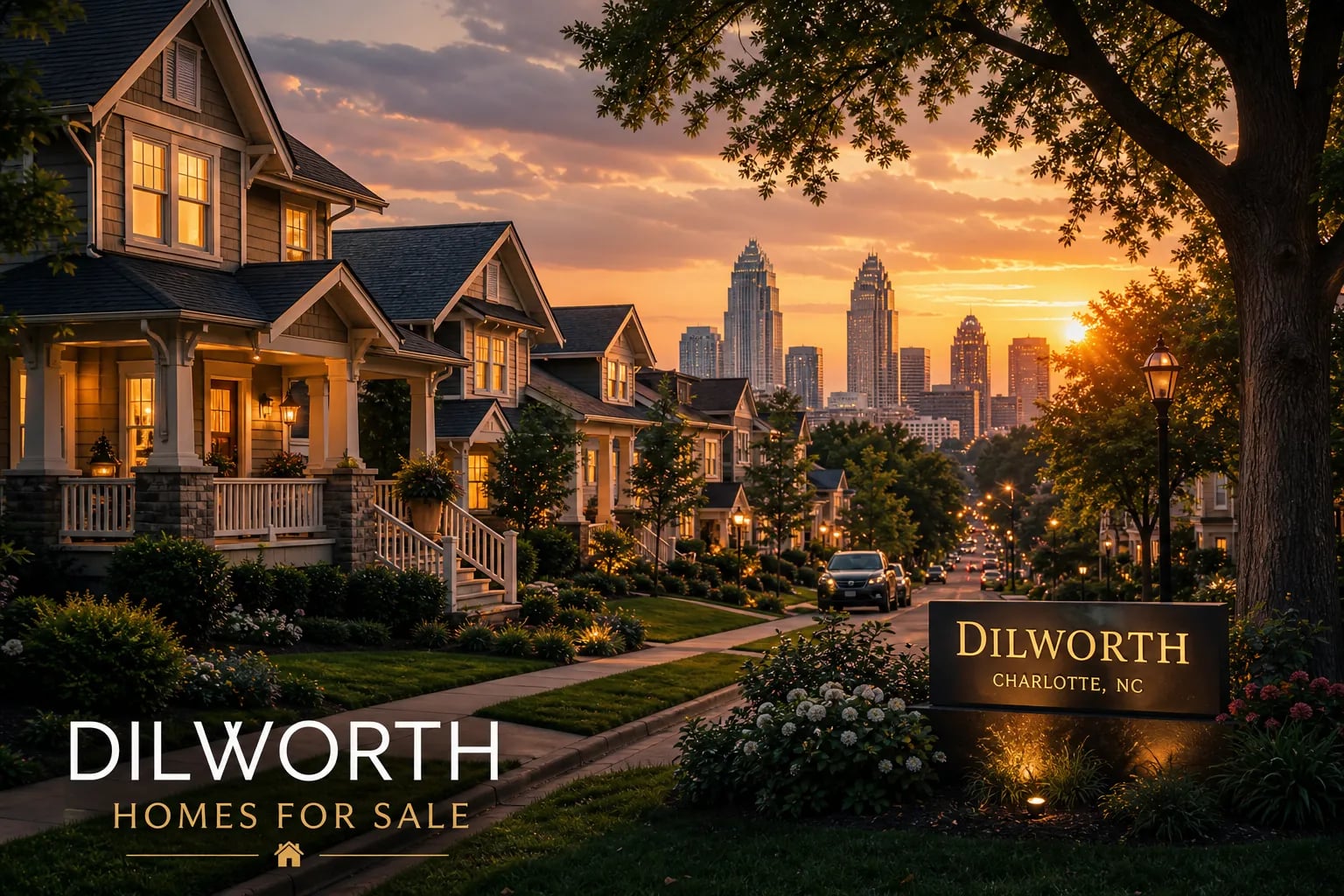
If you’ve been scrolling through Dilworth homes for sale for a few weeks, you likely have a shortlist of homes you want to see and feel close to ready. But somewhere between the listing photos and the asking price, something is nagging at you. You’re not sure whether the renovated bungalow you like has actually been renovated or just staged to look that way. You’re not sure whether the street it’s on will hold its value. And you’re not entirely certain what a fair offer even looks like in this market right now.
That feeling is the gap this guide is designed to close. Dilworth is one of Charlotte’s most competitive and nuanced urban neighborhoods, with bungalows that move fast, prices that have climbed sharply, and a market where the difference between a smart purchase and a costly one often comes down to what you know before you walk through the door. What follows is the same pre-tour briefing that a boutique advisor at Carolina Realty Advisors would give you on the way to your first showing: which homes are genuinely renovated versus cosmetically flipped, which streets command consistent resale value, and what inspectors find most often in Dilworth’s older housing stock.
Are you searching Dilworth, Charlotte NC or Dilworth, MN?
Before anything else: “Dilworth” returns results for two entirely different markets. One is an urban Charlotte neighborhood in Mecklenburg County, NC. The other is a small city in Clay County, Minnesota, with a completely different buyer demographic, price point, and market dynamic. If you haven’t filtered by state on the platforms you’re using, you may have spent time reviewing listings from the wrong place entirely. This guide covers Dilworth, Charlotte NC, specifically the 28203 and 28209 zip code areas bounded by South Boulevard, Morehead Street, and the South End corridor. All Dilworth NC listings, Dilworth property listings, and market data referenced below apply to the Charlotte neighborhood exclusively.
If you are searching for homes in Dilworth, MN, you can stop here. That is a legitimate market for the right buyer, but nothing in this guide applies to it. Set your location filter, confirm your state, and search from there.
What makes Dilworth Charlotte a distinct market
Dilworth is a genuine urban neighborhood with roots going back to the 1920s and 1930s. The streets are lined with mature tree canopy, the housing stock is predominantly arts-and-crafts bungalows, and the neighborhood sits within walking distance of Freedom Park, Latta Park, and the East Boulevard retail corridor. Walk Score is 81 (per walkscore.com). By car during off-peak hours, you can reach Uptown in under 10 minutes and South End in under five. The Charlotte Rail Trail and Little Sugar Creek Greenway connect Dilworth to a broader network of walkable and bikeable urban paths. That combination of character, location, and livability is why this neighborhood has consistently attracted buyers who want to live inside Charlotte, not just near it.
School assignments for most Dilworth addresses run through Dilworth Elementary on East Park Avenue, Sedgefield Middle, and Myers Park High School. Because Charlotte-Mecklenburg Schools assigns by exact address rather than zip code, confirm your specific assignment before you tour using the CMS school-locator tool at cms.k12.nc.us. That’s a one-minute check using your target street address.
Dilworth homes for sale: market snapshot
The headline number is this: the median sale price for homes for sale in Dilworth is approximately $975,000, up roughly 34% year over year based on recent MLS sales data. The median list price sits closer to $649,900, which creates a meaningful gap between what sellers are asking and what buyers are actually paying for homes that attract multiple offers. Active inventory ranges from 40 to 92 listings depending on the platform and boundary definition used, and average days on market falls between 39 and 70 days across reporting sources.
Those ranges are wide, and they matter. The variation comes from different sites using different MLS refresh windows and different neighborhood boundary definitions. What the data tells us clearly: Dilworth is not a slow market, and it is not a buyer’s market. It is also not uniformly a seller’s market. A significant share of inventory sits longer than it should at prices that don’t reflect a home’s actual condition. Recent sold comps show well-priced, genuinely renovated homes closing at 97% to 101% of list price, with price-per-square-foot figures clustering between $419 and $517 depending on the sub-area and renovation quality.
Dilworth homes for sale, current price bands
Dilworth’s price range is wider than most buyers expect. On the entry end, condos on Park Road start near $199,900 for a one-bedroom and range into the low $280s for two-bedroom units. Two-bedroom condos on Euclid Avenue fall between $435,000 and $650,000. Mid-market single-family homes, the four-bedroom renovated bungalows that define what most buyers picture when they think of Dilworth houses for sale, trade between $999,000 and $1.5 million. At the top end, custom builds on McDonald Avenue and Atherton Street are listed and selling north of $2.5 million, with the current market’s highest active listing sitting at $4.195 million.
Days on market and what they reveal about negotiating room
The homes sitting at 70-plus days are sitting for a reason. Either the price doesn’t reflect the condition, the condition has problems the photos don’t show, or both. Extended time on market is often where negotiating room actually exists, but only for a buyer who understands why the home is priced the way it is. Well-priced, move-in-ready homes close quickly and at or above ask. Stale listings require a different strategy entirely.
Renovated bungalow vs. cosmetic flip: how to tell before you step inside
This is the single most important distinction a Dilworth buyer can learn. The neighborhood’s housing stock is predominantly bungalows from the 1920s through the 1940s. Many have been genuinely renovated over the years. Some have been flipped with surface finishes that mask deferred maintenance and structural issues underneath. A high-volume agent will schedule the tour and let you fall in love with the kitchen. An advisory-style broker will help you read the home before you walk in the door.
Signs a renovation was done with genuine investment
Look for permits that were pulled and closed, not just started. In a well-executed renovation, the materials are consistent throughout the home rather than mixing eras or quality levels haphazardly. Mechanical upgrades are integrated cleanly: updated electrical panel, PVC or copper supply lines, newer HVAC with accessible returns. Original hardwoods are refinished, not covered. Original trim is restored rather than painted over or replaced with generic stock millwork. Listing photos that show the utility spaces, the crawl space access, the mechanical room, the attic ladder, signal that the seller and listing agent are not hiding anything. Agents often treat this kind of photographic transparency as a positive signal even before a showing is scheduled.
Red flags that point to a quick cosmetic flip
The patterns are recognizable once you know what to look for. Fresh paint applied over cracked plaster rather than patched walls. LVP flooring installed over uneven subfloors, where the surface looks clean but the bounce underfoot tells a different story. A renovated kitchen with granite and stainless steel while the electrical panel is still the original Federal Pacific or a mid-century Zinsco, both known fire hazards. Bathroom tile installed over original cast iron without confirmation that the drain lines have been scoped. And listing photos that show every room except the crawl space, the attic, and the mechanical room. When a listing avoids showing the spaces that inspectors care most about, that avoidance is information.
Which Dilworth streets consistently hold their value
Not every block in Dilworth performs the same. Pattern recognition at the street level is where a broker with 26 years concentrated in Charlotte’s urban core earns their fee. Buyers who know which streets attract repeat buyers and command consistent price-per-square-foot premiums can tour with a sharper filter and negotiate from a stronger position than buyers who are simply reacting to the next listing alert.
The blocks that drive resale demand
The interior residential streets near Latta Park, the Kenilworth corridor, and the blocks with walkable access to East Boulevard and Freedom Park consistently show the strongest resale performance. Based on recent sold comp data, Berkeley Avenue and Dilworth Road rank among the highest price-per-square-foot performers in the neighborhood. Note that some individual sales on those streets have exceeded $650 per square foot, though results vary by home condition and renovation quality, and those figures reflect a sample of recorded transactions rather than a guaranteed floor. Corner lots, lots with mature tree canopy, and homes on wider setbacks outperform on resale across market cycles. These are patterns visible across decades of transactions in the same zip code, not guesswork.
How price per square foot signals street-level quality
Recent comps show that $440 to $517 per square foot is the range for well-positioned Dilworth single-family homes. Outliers below $400 per square foot warrant scrutiny. A home priced at the low end of the range is almost always priced there for a reason the seller already knows about. That reason might be deferred maintenance, an inspection finding from a previous failed transaction, a dated mechanical system, or a street-level factor that suppresses resale demand. A buyer who tours a home at $390 per square foot without understanding why it’s there risks inheriting a problem that the seller has already priced into the ask.
Inspection red flags common in older Dilworth homes
Dilworth’s oldest homes are approaching 100 years old. Buying one means purchasing character, location, and a particular set of deferred maintenance risks that show up consistently in inspection reports. Understanding what inspectors typically find in this housing stock turns a tour into an informed due-diligence process rather than an emotional one.
Structural and foundation concerns in century-old bungalows
Older Dilworth homes frequently sit on pier-and-beam or block foundations with crawl spaces. Charlotte’s humidity, combined with decades of variable drainage, creates conditions where crawl spaces collect moisture and the structural wood underneath the house degrades over time. Inspectors regularly flag sagging floor joists, inadequate vapor barriers, evidence of wood rot or pest damage, and foundation piers that have settled unevenly. These findings range from straightforward negotiation points to deal-killers depending on severity. Remediation costs vary widely, a crawl space moisture fix and a major structural repair are not in the same category, and the difference isn’t always visible during a showing. Having an advisor who has navigated both outcomes in this specific neighborhood changes how you interpret an inspection report.
Electrical, plumbing, and HVAC systems to scrutinize
Original knob-and-tube wiring was standard in 1930s construction and is still present in some Dilworth homes that have not had a full electrical renovation. Federal Pacific and Zinsco panels from mid-century updates are known fire hazards and are consistently flagged by inspectors. Cast iron drain lines deteriorate with age and are a common finding in homes where only the kitchen and bathrooms have been updated. Galvanized supply lines corrode from the inside out, reducing water pressure and eventually failing. HVAC systems in homes with poor attic ventilation work harder and fail sooner than their rated lifespan suggests. A buyer who tours a Dilworth bungalow without knowing which of these systems have been addressed is walking into a negotiation without the full picture.
Why boutique broker expertise is a strategic advantage in Dilworth
In a market where homes sell at 97% to 101% of list price and well-priced inventory moves in under 40 days, the value of broker expertise is not access to listings. Every buyer has access to listings. The value is pattern recognition: knowing which inspection findings are routine, which are deal-killers, and which are legitimate negotiating leverage. Knowing which streets are seeing price compression and which are holding. Knowing when a freshly renovated bungalow is worth the ask and when it’s a flip priced for the next buyer’s inspection surprise.
What high-volume team agents miss in a neighborhood like this
An agent handling 50-plus transactions a year across multiple Charlotte markets often lacks the block-level familiarity that comes from years of concentrated Dilworth transaction history. That workflow, handoffs, standardized checklists, tour-feedback forms, processes deals efficiently. It does not advise on neighborhoods. The gap shows up most clearly when an inspection report lands and someone has to decide within 48 hours whether a finding is a renegotiation, a repair request, or a reason to walk away.
How Carolina Realty Advisors approaches a Dilworth transaction
Broker-owner Mike Sposato has worked Dilworth and Charlotte’s urban core for over 26 years and more than 1,500 closings. Every client at Carolina Realty Advisors gets direct broker representation, no team handoff, no hand-off to a coordinator. That means inspection triage, offer strategy, and neighborhood-specific counsel come from the same person who has seen comparable properties on that block transact before. When you’re deciding whether to offer on a bungalow on Kenilworth or walk away from a flip on a side street, that experience is worth more than any listing platform can provide.
Your next step before you schedule that first tour
Dilworth homes for sale represent one of Charlotte’s most competitive and most nuanced opportunities for urban buyers. The buyers who win here are not necessarily the ones who move fastest. They are the ones who tour with the right intelligence, know what to look for in an older bungalow, understand which streets hold value across market cycles, and have a broker who can translate an inspection report into a negotiation strategy on the spot.
Before you schedule your next showing, use the price bands and street-level data in this guide to sharpen your shortlist. Know what price per square foot to expect on the street you’re targeting. Know which mechanical systems you’ll ask about before you walk in. Know whether the listing photos are showing you the whole house or just the parts that photograph well.
When you’re ready to tour Dilworth houses for sale with a broker who knows the neighborhood at the block level, reach out to Carolina Realty Advisors. Mike works directly with every client, no team handoffs, no referral to a junior agent. If you want that kind of representation before your first offer on a Dilworth property listing, that’s the conversation to start.