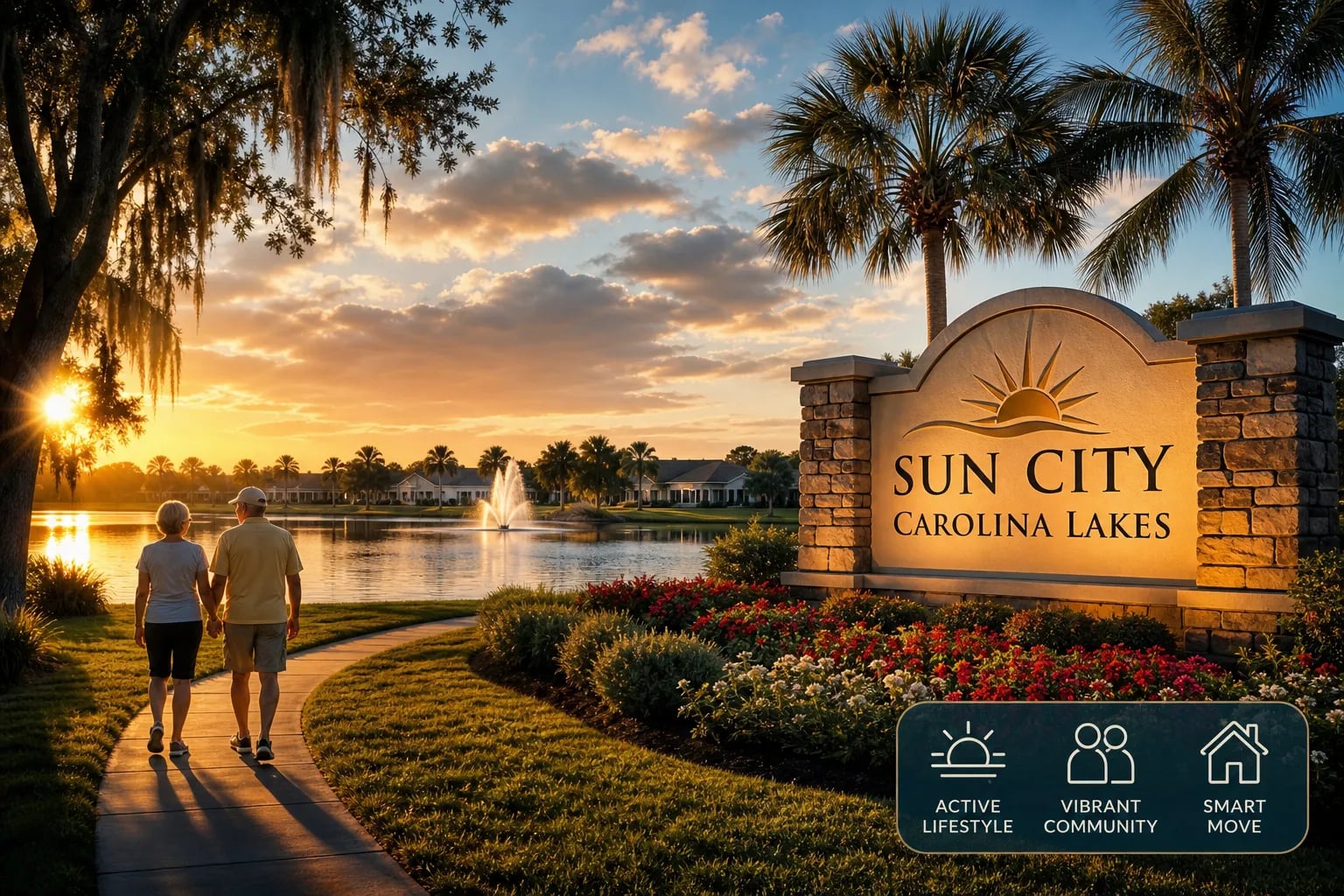
Every week, buyers researching active adult communities near Charlotte mention Sun City Carolina Lakes first. That’s not an accident. The Del Webb development in Indian Land, SC has built a strong reputation, and much of it is deserved. But buyers who rely only on the amenity brochure frequently get surprised by what they didn’t ask about: HOA covenants, Lancaster County tax math, and how resale inventory actually moves in this specific zip code.
At Carolina Realty Advisors, Mike Sposato has walked buyers through this community across multiple market cycles. The firm holds dual NC/SC licensure and has direct, current CMA data on what homes here are actually selling for in 2026, not just what the builder’s marketing suggests. This article covers five things every serious buyer needs to understand before making an offer: the community’s location and what it means financially, the amenity picture, the HOA rules that catch buyers off guard, the current resale market, and an honest assessment of whether this community is actually the right fit.
What Sun City Carolina Lakes is and why its location matters
Sun City Carolina Lakes is a Del Webb master-planned active adult community located in Indian Land, Lancaster County, South Carolina, just south of the NC/SC state line. The Del Webb name carries specific meaning for buyers who’ve done any research: it signals a certain level of amenity investment, community design intentionality, and a social infrastructure built around resident life rather than quiet cul-de-sacs. That brand promise holds up reasonably well here.
The location across the state line is not just a geographic footnote; it’s a real financial variable. Lancaster County’s effective property tax rate runs approximately 0.45% to 0.54%, compared to Mecklenburg County’s rate of roughly 1.05% to 1.13%. On a $500,000 home, that gap translates to roughly $2,500 to $3,100 per year in tax savings. For buyers comparing sticker prices on homes across the state line without factoring in the full monthly cost picture, the numbers can look very different than expected. A broker licensed in both states can model the actual monthly payment for both sides of the border, a conversation a Charlotte-only agent often can’t have with the same precision.
The community is built for active retirees, downsizers, pre-retirees, and relocation buyers arriving from the Northeast and Midwest. Low-maintenance living with a structured social calendar is the core value proposition. Buyers expecting a quiet, unscheduled retirement community should recalibrate before they tour.
Amenities that drive demand (and justify the HOA fee)
The amenity package here is substantial. The community offers two large amenity centers totaling more than 53,000 square feet of indoor space, including a fitness center, ballroom, indoor lap pool, multiple outdoor pools, aerobics and dance studios, a library, a computer lab, and classroom space. Outdoor amenities include tennis courts, pickleball courts, bocce, horseshoes, walking and biking trails, a community garden, dog parks, lake fishing access, and kayak launch areas along the Catawba River corridor. For buyers comparing Sun City Carolina Lakes to smaller, thinner active adult developments in the Charlotte region, the amenity depth is a genuine differentiator.
The social layer is what residents actually talk about. The community supports more than 200 resident-organized clubs and a year-round activity calendar managed by a full-time lifestyle director. This is not a passive amenity; it requires participation to deliver value. Buyers who plan to engage with the calendar, join clubs, and use the facilities regularly will likely feel the community delivers on its promise. Buyers who want the option but don’t plan to use it regularly should think carefully about whether the HOA fees are a good trade-off for their lifestyle.
Golf deserves a specific note because it generates buyer confusion. The community has an 18-hole course that winds through the development and is accessible to the public. Golf membership is not included in the standard HOA fee. It’s an optional, separately priced membership. Buyers who assume golf is covered are sometimes surprised when they get to the full cost picture.
Age Restrictions
The age restriction works as follows: at least one resident in each home must be 55 years of age or older, and no person under 19 may reside in the home permanently. Visitors under 19 are permitted for limited periods, but this community is not structured for multi-generational living arrangements. Buyers who have adult children or grandchildren who might want to live with them long-term need to understand this rule clearly before they make an offer, not after they’re under contract.
HOA rules every buyer needs to read before closing
Fees and Assessments
HOA fees currently run between approximately $321 and $578 per month, depending on the home type and specific property. The fee typically covers lawn care, common area maintenance, and access to community amenities. What it does not cover is golf, certain lifestyle program fees, or any special assessments the board may levy for capital projects. Buyers should request the HOA’s current financials and reserve fund status as part of their due diligence. A community with thin reserves is a community where a special assessment is more likely down the road.
Rental restrictions, architectural review requirements, and CC&R covenants are standard elements of the HOA structure here. Short-term rentals are generally not permitted in age-restricted Del Webb communities, and exterior modifications require architectural review board approval. These rules protect property values and community character. Even so, they routinely surprise buyers who didn’t read the documents carefully. Your buyer’s agent should walk you through the CC&Rs and resale certificate before you make an offer, not hand them to you as closing homework.
Resale values and what the current market looks like
As of 2026, resale homes in Sun City Carolina Lakes are trading in the $480,000 to $514,000 range depending on floor plan, lot position, and upgrades. Price per square foot runs approximately $241 to $274. These figures are meaningful context, but a proper CMA for a specific floor plan within a specific section of the community tells a more precise story. Carolina Realty Advisors maintains current, community-specific data on this development and can pull a meaningful comparison for buyers evaluating a specific listing rather than a broad neighborhood average.
Days on market are currently running around 75 days for this community specifically, which is longer than peak-cycle figures. This gives buyers more negotiating room than the market offered two and three years ago, but desirable floor plans at competitive prices still attract attention. Inventory in certain price bands can be thin. Buyers who have a strong preference for a specific floor plan may need to be patient or willing to compete when the right home appears.
What holds resale value inside Sun City Carolina Lakes is consistent with what holds value in any master-planned active adult development: single-level floor plans with open layouts and kitchens and primary bathrooms that were either built or upgraded to current buyer expectations. Lots that don’t back directly to commercial or heavy traffic areas also hold a clear advantage. Dated finishes and awkward lot positions are the most common factors that push homes toward the lower end of the price range. This is the kind of pattern recognition a locally experienced broker brings to the conversation that a generalist agent pulling MLS comps simply can’t replicate.
Is Sun City Carolina Lakes actually the right fit?
The buyer who thrives here is socially engaged, comfortable with a structured community environment, and values low-maintenance living with predictable infrastructure. If you want a neighborhood where your lawn is handled, your calendar has options without requiring you to create them, and your neighbors are in a similar life stage, this community delivers. Buyers who prioritize privacy, minimal HOA involvement, or completely unstructured days often find the community doesn’t match their expectations.
A few things buyers sometimes don’t anticipate: the commute into Charlotte’s urban core matters more than it looks on a map, particularly for buyers who still work part-time, want frequent access to uptown restaurants, or have family in the city. The location is suburban-to-rural in character, and Indian Land lacks the walkable urban amenities that some buyers expect to stay close to. As the community has grown, some residents report that amenity spaces can feel crowded during peak programming periods, with popular events selling out and facilities operating at or near capacity.
Buyers in this search regularly compare several communities: Sun City Hilton Head in Bluffton, SC; Cresswind Charlotte in Harrisburg, NC; and communities such as Sun City Center in the greater Tampa Bay area, which offers a useful benchmark for how large-scale active adult developments handle amenity capacity at full build-out. A thorough buyer’s agent will help you compare community fit, lifestyle match, and financial structure across your top candidates before narrowing to one. The goal is the right community for your specific priorities, not just the most well-known name in the search results.
How the buying process works here and why representation matters
On-site sales agents at the Del Webb welcome center represent the developer, not the buyer. They are professional, knowledgeable about the product, and incentivized to close sales. That’s not a criticism; it’s simply the structure. An independent buyer’s agent with direct community experience can do something the on-site team cannot: review HOA documents critically on your behalf, advise on resale value for specific floor plans, and negotiate terms that protect your interests rather than the seller’s. In most cases, the buyer pays nothing additional for independent representation, as the seller covers commission.
Before making an offer, buyers should have reviewed the HOA financials and reserve fund, the CC&Rs and any pending rule changes, the resale certificate, and an inspection plan appropriate for the home’s age and construction type. Newer construction carries its own inspection considerations; it’s not immune to issues, and buyers who waive inspections on new or recent builds often regret it. These are the documents and conversations that separate a well-represented buyer from one who closes with surprises.
The honest bottom line
Sun City Carolina Lakes is a well-built, well-amenitized active adult community with real financial advantages tied to Lancaster County’s property tax structure. For the right buyer, it delivers on its promise. But the right buyer is someone who has looked past the brochure and understands the HOA rules, the monthly cost math, the current resale market, and what daily life in this specific community actually looks like in 2026.
If you’re researching Sun City Carolina Lakes and want a conversation grounded in current data and honest pattern recognition, reach out to Carolina Realty Advisors directly. Mike Sposato has closed transactions in this market, holds dual NC/SC licensure, and will give you a real picture of the community, not a sales pitch. Reach out to request a current CMA, review the community’s HOA documents together, or simply talk through whether this development fits your actual retirement priorities before you start touring.