
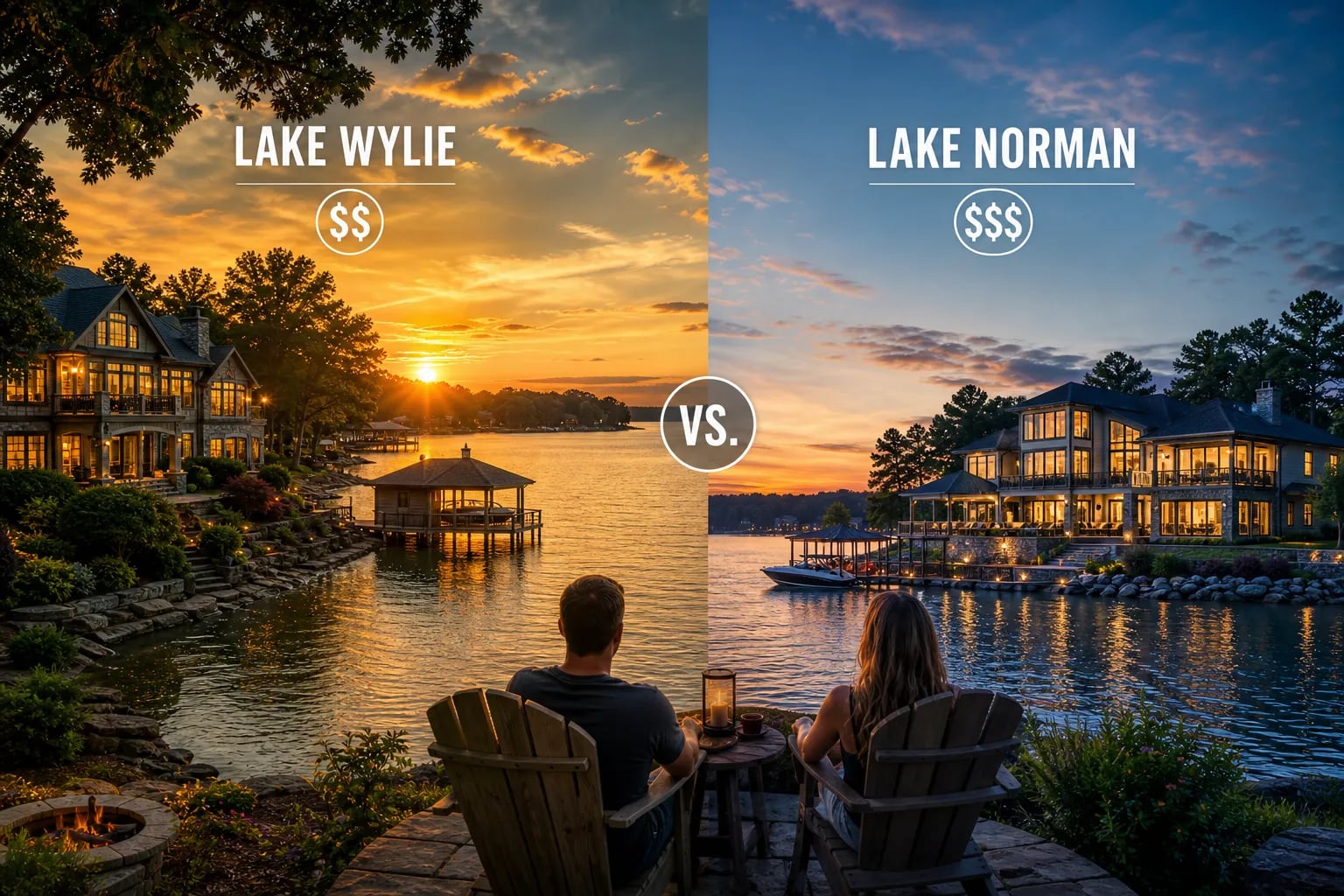
You’ve seen the dock. You’ve watched the sunset from the back deck. Your mind is already picking out furniture. That emotional pull is real, and it’s exactly why lakefront buyers routinely get surprised after closing by carrying costs they never modeled before making an offer. Two buyers, each purchasing a $750,000 waterfront home, one on Lake Wylie’s South Carolina side and one on Lake Norman in North Carolina, can face an annual cost difference of $4,800 to $9,600 or more. Not because of price. Because of property taxes, insurance, HOA dues, and dock fees stacked beneath the listing.
At Carolina Realty Advisors, Mike Sposato builds a real carrying cost sheet for every lake buyer before emotions lock in a decision. With dual licensure in both North Carolina and South Carolina and extensive experience working both markets, he’s seen the tax bill alone reshape a buyer’s actual monthly budget by hundreds of dollars. That’s the number that matters, and it’s almost never on the listing sheet.
This article breaks down the side-by-side costs for anyone weighing Lake Wylie SC vs. Lake Norman NC: property taxes, homeowners and flood insurance, HOA dues, dock permitting fees, and the lifestyle factors that affect your daily experience and long-term resale value. By the end, you’ll know what questions to ask and what numbers to pull before you fall in love with a listing on either lake.
Why the Purchase Price Is Only Half the Conversation on Lake Wylie SC vs. Lake Norman NC
The carrying cost difference that surprises most lake buyers
Annual carrying costs on a lakefront home include property taxes, homeowners insurance, flood insurance, HOA dues, and any dock or waterfront-specific fees. On a $750,000 home, those recurring costs can add $9,000 to $16,500 per year depending on which lake and which county you’re in, a range derived from stacking the actual tax, insurance, HOA, and dock-fee line items detailed throughout this article. That gap translates to a real monthly payment difference that often matters more than a $25,000 swing in asking price. Buyers focused on the listing price routinely underestimate this math.
The reason the gap is so wide: each cost category is jurisdiction-specific. Property taxes follow county assessment rules. Flood insurance follows FEMA flood zone designations at the parcel level. HOA dues are set by each subdivision. These numbers don’t show up automatically in a mortgage estimate, and many agents don’t compile them into one place prior to writing an offer.
Why cross-state comparison is harder than it looks
Lake Wylie straddles North and South Carolina, with a significant concentration of higher-priced waterfront parcels and established waterfront communities sitting on the York County, SC side. Lake Norman spans Mecklenburg, Iredell, and Catawba counties, all in North Carolina. Each jurisdiction runs its own tax rate, assessment methodology, and permitting process. A single-state agent can walk you through their market in depth, but they may lack the licensing or local tax and permit familiarity to fully compare the other side, a practical limitation that matters most when the financial picture depends on jurisdiction-specific details like York County’s 4% assessment ratio.
Property Taxes: The Biggest Cost Gap in Any Lake Wylie SC vs. Lake Norman NC Comparison
How South Carolina’s 4% assessment ratio works in Lake Wylie buyers’ favor
South Carolina taxes owner-occupied homes on a 4% assessment ratio, which means the taxable value used to calculate your bill is a fraction of the purchase price. In York County, SC, the effective property tax rate for Lake Wylie-area waterfront properties runs roughly 0.53% to 0.66%. On a $750,000 home, that translates to approximately $3,975 to $4,950 per year. This is the most consistent financial advantage for buyers choosing the SC side of the lake.
Mecklenburg County, NC runs an effective property tax rate of approximately 0.71%. On that same $750,000 home, the annual tax bill comes in closer to $5,325. Iredell County communities add local municipal and district levies on top of the base county rate of $0.50 per $100 assessed value. The tax gap between comparable homes on each lake can run $800 to $1,500 per year before you’ve touched insurance or HOA dues.
Why the county median doesn’t always predict your specific bill
The countywide effective rate is a useful starting point, but your actual bill depends on local school district millage, municipal levies, and special tax districts layered on top of the base county rate. A home on the Clover side of Lake Wylie will carry a different millage than one near Rock Hill. A Lake Norman property in Mooresville carries different rates than one in Davidson. Always verify the tax bill on the actual parcel, not just the county average. This is one of the first steps an experienced lake-market advisor takes before a client submits an offer.
Homeowners and Flood Insurance: Where the Lake’s Location Changes Your Premium
What Lake Wylie SC waterfront owners typically pay
For Lake Wylie homeowners on the South Carolina side, the average homeowners insurance premium runs approximately $2,025 per year. That figure climbs with higher dwelling replacement values: homes insured for $800,000 to $900,000 in replacement cost can see premiums closer to $3,000 per year. Waterfront properties pay more than their inland neighbors because of wind exposure, water proximity, and the added replacement cost of dock or boathouse structures.
The flood insurance cost most buyers forget to factor in
Standard homeowners insurance does not cover flood damage, including rising lake water. A separate NFIP flood policy in South Carolina averages approximately $747 per year. Whether your Lake Wylie property sits in a designated flood zone depends on the specific parcel, but waterfront and near-water homes are more likely to require or benefit from this coverage. Budget for both policies as a package: roughly $2,772 per year all-in for a typical Lake Wylie SC waterfront home at moderate dwelling values.
How Lake Norman insurance costs compare
Waterfront homes on Lake Norman face a higher insurance cost structure. Standard homeowners insurance for lakefront properties in North Carolina runs approximately $3,000 to $3,400 per year, compared to the $2,676 statewide North Carolina average. When flood insurance is added, comprehensive waterfront coverage commonly lands between $4,000 and $8,000 per year depending on flood zone, replacement value, and dock structures. A realistic midpoint for a typical Lake Norman waterfront home is $5,000 to $6,000 per year all-in. That’s a meaningful gap compared to the Lake Wylie SC baseline, and it’s entirely independent of which lake is prettier.
HOA Fees and Dock Permitting: The Monthly Costs Buyers Overlook
What typical HOA dues look like in lake communities
Established waterfront subdivisions on Lake Wylie, SC typically carry HOA dues of $200 to $600 or more per month, depending on amenities like gated access, shared boat ramps, pools, and trail systems. River Hills, one of the better-known Lake Wylie communities, runs $203 to $233 per month. Lake Norman communities in Cornelius, Mooresville, and Sherrills Ford generally run $100 to $400 per month, with higher dues in amenity-heavy or luxury subdivisions. At $250 per month, you’re looking at $3,000 per year, a number that belongs in your carrying cost total.
The dock permit layers that add time and cost on the SC side
Getting a private dock permitted on the South Carolina side of Lake Wylie requires approval from Duke Energy for the shoreline structure, a South Carolina DNR Navigable Waters Permit for the dock itself, and county review for the electrical connection. The SCDNR residential dock permit carries no state fee, but the SCDNR portion alone typically takes 45 to 60 days for a complete application; the full end-to-end process, including Duke Energy review, county electrical sign-off, and any HOA approval, can stretch to 60 to 180 days depending on scope. On Lake Norman in North Carolina, the standard permitting stack is Duke Energy plus county building or electrical permits, generally without a separate state navigable-waters permit for a residential dock. The NC side is still a multi-step process, but it typically involves one fewer regulatory layer.
Why a dock in the wrong name is a transaction problem
An existing dock on a lakefront property needs to be properly permitted and titled to transfer cleanly at closing. If the permit sits in a previous owner’s name or was never formally issued, untangling it adds both time and legal cost. This detail trips up buyers who move fast on a lakefront listing without verifying the permit stack first. It’s one of the first things Mike Sposato checks before a client makes an offer on any lake property, on either lake.
Lifestyle Tradeoffs That Affect Your Daily Experience and Long-Term Value
Lake size, boating traffic, and what it feels like on a summer Saturday
Lake Norman covers roughly 32,475 acres across four counties, making it one of the largest man-made lakes in the Southeast. Lake Wylie covers approximately 13,400 acres. That size difference shows up on a summer weekend: Lake Norman can absorb more boat traffic before it feels crowded, while Lake Wylie’s tighter shoreline and narrower coves create a more intimate environment. Some buyers prefer the quieter pace; others want open water for skiing or large-boat navigation. Know which experience you’re buying before you fall in love with a specific dock.
School districts: Clover on Lake Wylie versus the Lake Norman options
For families with school-age children, the school district attached to a specific address is non-negotiable. The SC side of Lake Wylie falls mostly within Clover School District, which holds an A overall grade on Niche and ranks second among all South Carolina school districts statewide. Lake Norman’s school picture is more variable: Mooresville Graded School District carries an A rating on Niche, while Iredell-Statesville Schools and Charlotte-Mecklenburg Schools serve other parts of the lake with different results by attendance zone. Quality on the Lake Norman side must be verified for the specific address, not assumed based on the county name.
Commute to Charlotte and the daily-drive reality
Based on typical drive-time estimates from representative addresses, Lake Wylie’s SC side puts most buyers 20 to 35 minutes from Uptown Charlotte under normal conditions. Lake Norman’s communities range from Cornelius at roughly 25 minutes to Mooresville and Sherrills Ford at 40 to 50 minutes during peak commute hours. For hybrid workers heading into the office two or three days a week, the difference is manageable. For five-day office commuters, the northern end of Lake Norman adds real time and fuel cost to the monthly budget that won’t show up on any listing sheet.
Putting the Real Numbers Together Before You Make an Offer
What a side-by-side monthly carrying cost looks like
On a $750,000 waterfront home, a Lake Wylie SC buyer looking at York County taxes, average homeowners and flood insurance, and mid-range HOA dues faces roughly $750 to $1,050 per month in recurring non-mortgage costs. A comparable Lake Norman buyer, factoring in Mecklenburg or Iredell County taxes, higher insurance premiums, and HOA dues, faces roughly $1,100 to $1,700 or more per month. That monthly gap of $400 to $800 or more is where property taxes and lifestyle costs on Lake Wylie SC vs. Lake Norman NC genuinely diverge, and it’s entirely independent of the asking price.
The four checks to run before any offer goes in
Before making an offer on a lakefront property on either lake, pull the most recent actual tax bill from the county parcel records and verify it matches what the seller’s agent is quoting. Get homeowners and flood insurance quotes based on realistic dwelling replacement cost estimates, not round numbers. Confirm the HOA dues, rules, and any pending assessments in writing. And verify that any existing dock has a valid, transferable permit in the correct name. These four checks take a few days and can prevent a carrying cost surprise that fundamentally changes the financial case for a property.
Why dual-state licensure changes the quality of advice you get
Many agents in this regional market are licensed in one state. That creates a practical boundary where the comparison gets thin: a North Carolina agent can walk you through Lake Norman tax bills with confidence, but they may not be positioned to explain how York County SC’s 4% assessment ratio reshapes your budget on the Lake Wylie side. Mike Sposato holds active licensure in both North Carolina and South Carolina, which means clients get the full comparison handled under one roof, from one broker who knows the actual numbers on both sides of the state line.
The Choice Between These Two Lakes Is Genuinely Competitive
When evaluating Lake Wylie SC vs. Lake Norman NC property taxes and lifestyle side by side, the financial picture is clear: Lake Wylie typically wins on property taxes, insurance costs, and school district consistency. Lake Norman wins on lake surface area, wider community variety, and stronger name recognition for resale. The monthly carrying cost difference on a $750,000 home, factoring in taxes, insurance, and dock fees, can run $400 to $800 or more depending on the specific communities you’re comparing. Neither number is right or wrong: it depends on how you use the water, where you work, and what your long-term resale horizon looks like.
Running this comparison correctly requires knowing both markets at the parcel level, not just by state. The smartest move before you make any decisions is to get the actual carrying cost comparison built for the specific homes you’re considering, so you’re evaluating the real monthly number and not just the listing price. Reach out to Mike Sposato directly at Carolina Realty Advisors to get that cost sheet built for the specific properties you’re comparing on Lake Wylie or Lake Norman, it’s the step that changes the conversation from which home looks better to which home actually works for your budget.