
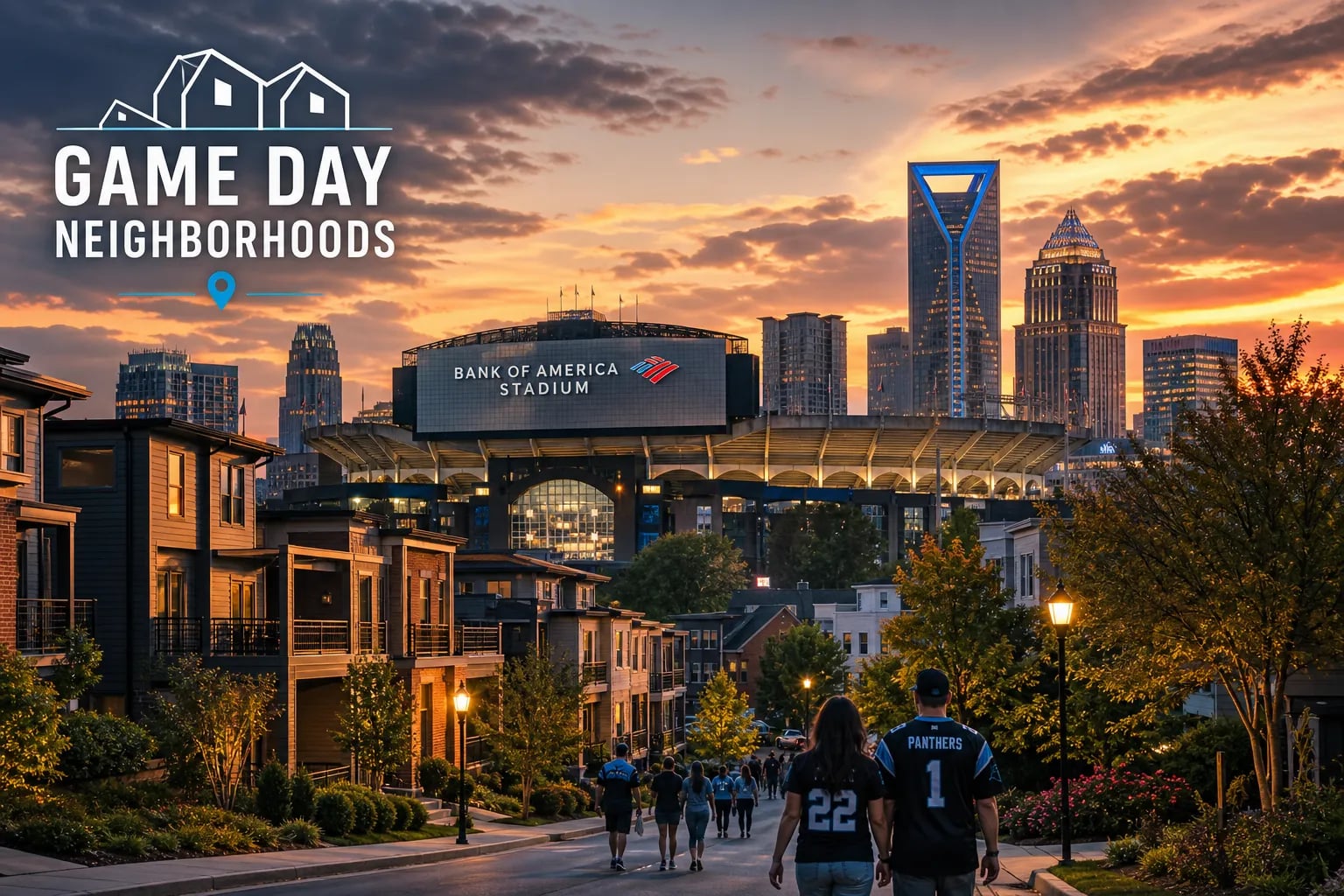
If you’re searching for homes near Bank of America Stadium, the decision involves far more than Panthers season tickets or Charlotte FC match nights. It’s about planting yourself in one of Charlotte’s most connected urban corridors, where walkability, light rail access, and genuine neighborhood energy are present 365 days a year, not just on game weekends. The stadium sits on the western side of Uptown, and the neighborhoods surrounding it cover a wide range in price, housing type, and day-to-day character.
Many buyers researching homes near Bank of America Stadium focus on proximity and stop there. That’s where mistakes get made. The blocks that feel walkable on a Tuesday don’t all behave the same way after a sold-out Panthers game, and not every condo priced for a “stadium premium” actually delivers the walkability the listing promises. What follows is the neighborhood-level detail that comes from decades of closing transactions on these specific Charlotte streets, covering which neighborhoods to target, what properties actually cost, how event nights affect daily life, and which areas hold long-term value.
Which neighborhoods are actually within walking distance of the stadium
Third Ward is the neighborhood most directly connected to Bank of America Stadium, both physically and culturally. The stadium itself sits within Third Ward, and most condo buildings in the neighborhood put residents within a five- to fifteen-minute walk of the gates. The housing texture here reflects that proximity: mid-rise condos, converted lofts, and some townhome-style units along key corridors. Median condo prices in Third Ward run approximately $420,000 to $475,000, with HOA fees ranging broadly from around $200 to $973 per month depending on the building and its amenities.
Second Ward and Uptown proper: high-rise living with maximum access
Second Ward and the broader Uptown condo market represent the high-density, high-amenity option for buyers who want skyline views, concierge services, and a fully urban lifestyle. Building types here run from luxury high-rises to mixed-use residential towers. Transit access is exceptional, with LYNX Blue Line stations, CityLYNX Gold Line stops, and CATS bus routes all within reach. Entry-level Uptown Charlotte homes and condos in this corridor start in the mid-$200,000s for smaller units, while premium residences with better views and larger floor plans push well past $1 million.
South End: walkable with more neighborhood character
South End is roughly a 15- to 20-minute walk from the stadium or a single LYNX Blue Line stop, which makes it the strongest blend of walkability and neighborhood texture for buyers who don’t want full high-rise urban living. The converted industrial streetscape, mix of condos and townhomes, and lively retail-and-restaurant corridor give South End a character that feels distinct from Uptown’s density. Its Walk Score of 74 sits just above Third Ward’s 72, and light rail access along the Blue Line has made South End one of Charlotte’s stronger urban investment stories over the past decade, values there track closely with the transit infrastructure.
Dilworth: the closest single-family market worth watching
Dilworth is the neighborhood for buyers who want a house rather than a condo. It sits immediately south of the stadium corridor and carries the highest Walk Score of the three primary neighborhoods at 78. Dilworth isn’t a five-minute walk to the gates, but it’s the closest market offering bungalows, craftsman homes, and traditional single-family inventory near the urban core. Its neighborhood character, tree-lined streets, and strong demand from buyers seeking walkable urban-adjacent living make it the most competitive single-family market in this corridor.
What homes near Bank of America Stadium actually cost
The price range for houses and condos near Bank of America Stadium spans every budget tier, and knowing where you fall determines which neighborhoods are realistic for your purchase. Entry-level condos in Third Ward and Uptown start around $175,000 to $280,000 for smaller square footage in older or more modest buildings. The mid-range tier, covering more spacious condos and townhomes in South End and select Third Ward buildings, runs from roughly $350,000 to $600,000. At the premium end, luxury Uptown high-rises and the better Dilworth single-family inventory can reach $800,000 to $1.5 million and beyond.
Each tier comes with real tradeoffs. Entry-level condos at the lower end often mean tighter floor plans, older building systems, or less desirable upper floors. The mid-range in South End tends to offer better construction quality and stronger HOA financials. The premium Uptown tier delivers amenities and views, but buyers need to look carefully at HOA reserves before committing at that price point, a thin reserve fund can signal deferred capital improvements that fall to owners after closing.
Long-term rental ranges if you’re not ready to buy
For renters testing the neighborhood before purchasing, or investors evaluating yield potential, the rental market reflects the proximity premium clearly. Uptown one-bedrooms average around $1,429 per month, while Third Ward runs closer to $1,856 per month for the same unit size, reflecting how much the market values those extra walkable blocks to the stadium. House rentals near the corridor span a much wider range, from around $1,395 for a studio on the edge of the area to over $6,000 per month for a three-bedroom home. If you’re deciding between renting for a year and buying now, that rental data also gives you a reasonable yield benchmark for investment-oriented purchases.
Walkability, transit, and what event nights actually mean for residents
Walk scores and transit access near the stadium are above average by Charlotte standards. The LYNX Blue Line, CityLYNX Gold Line, CATS bus routes, and multiple bike-share stations all serve this corridor. For most daily errands and Center City commutes, a car is optional rather than required, especially for residents in Third Ward, South End, and Dilworth, where Walk Scores range from 72 to 78.
How the light rail and CityLYNX Gold Line change the commute equation
The LYNX Blue Line connects South End and Third Ward directly into Uptown, making car-free living realistic for residents who work in Center City or along the South End employment corridor. The CityLYNX Gold Line’s surface connections run through the stadium area itself, and buyers comparing condos in Third Ward versus South End will find transit access roughly equivalent between the two. This matters beyond daily convenience: in Charlotte’s urban neighborhoods, proximity to light rail has historically tracked with stronger long-term resale performance, and it’s one of the clearest signals for appreciation potential in this market.
What to expect on Panthers and Charlotte FC game days
Event-night reality deserves a direct answer. Following games, road closures along Morehead Street between Clarkson Street and South Tryon Street go into effect, and drivers are directed away from the stadium in specific patterns. South Mint Street, Brooklyn Village Avenue, and Graham Street also face closures or restrictions depending on the event. Street parking near the stadium is heavily restricted on event days. More than 30,000 structured parking spaces are available within a 10- to 15-minute walk; these garages serve as the practical solution for most attendees. For residents, the main adjustment is timing: foot traffic increases significantly before and after events, and Morehead Street access is disrupted immediately post-game. This is manageable, but it’s worth factoring into your daily routine expectations before you sign a contract on a unit that faces Morehead directly.
Short-term rental potential if you’re buying as an investor
Proximity to a major NFL and MLS venue creates real short-term rental demand. Baseline nightly rates for budget-to-midrange stays within a mile of the stadium run approximately $130 to $225 per night, with upscale options starting around $330 and climbing higher during major event weekends. Game nights cause both tightening availability and premium pricing, and the most walkable inventory inside a one-mile radius books earliest. January and June tend to offer better availability during non-event periods, which affects annual occupancy projections for investors building a yield model.
The practical decision for investors comes down to HOA covenants, not just proximity. Condos in Third Ward and Uptown command the highest event-weekend premiums because of pure walkability, but building rules on short-term rentals vary significantly, some prohibit nightly rentals outright, while others impose restrictions on frequency or minimum stay length. HOA covenants were not available in standard MLS listings for every building reviewed, so this due diligence step cannot be skipped. South End and Dilworth may offer more flexibility in some buildings, but covenant language differs property by property. Verify HOA covenants on specific buildings before making an offer with this strategy in mind. A building that looks ideal on paper can kill an investment thesis entirely if the covenants prohibit nightly rentals, and that language isn’t always easy to find in a standard MLS listing.
Long-term appreciation: which neighborhood holds value best
Not all walkable urban condos near the stadium appreciate equally. The difference between a well-positioned buy and an expensive mistake is often block-level knowledge, not neighborhood-level data. The core appreciation drivers in this corridor are LYNX Blue Line proximity, original construction quality versus cosmetic renovation, HOA financial health, and the broader urban densification story that continues to play out across South End and Third Ward as Charlotte grows.
South End has been one of Charlotte’s stronger urban appreciation stories, tied closely to the light rail corridor investment. Values there track with the transit infrastructure, and that infrastructure isn’t going away. Third Ward values are more tightly linked to stadium and mixed-use development activity, which creates upside but also makes them more sensitive to development cycles. Dilworth delivers single-family options with solid walkability to the stadium corridor and strong neighborhood-level demand in Charlotte’s urban core, but detached homes there come at higher price points than most condos in the stadium-adjacent market.
The tradeoff by neighborhood looks like this: Third Ward delivers maximum proximity and event-economy upside with a limited housing type mix. South End offers solid appreciation fundamentals, walkable retail, and an established condo resale market. Dilworth gives buyers single-family options with excellent walkability and neighborhood character, but requires a larger budget for detached homes. Which neighborhood is “best” depends entirely on your specific use case, hold period, and budget.
Why local pattern recognition matters before you make an offer here
The data in this guide covers the broad strokes. What actually protects a buyer in this market is knowing what the data doesn’t surface: which buildings have deferred maintenance covered by a thin HOA reserve, which blocks in South End are still transitioning versus fully established, and whether a condo listed as “renovated” was updated with resale-quality finishes or flipped quickly with cosmetic changes. Those distinctions don’t show up in a Zillow photo gallery.
A broker who has spent decades personally closing transactions on these specific Charlotte urban blocks reads a listing differently than someone working from the same photos you see online. Mike Sposato at Carolina Realty Advisors has built deep neighborhood-level pattern recognition across Uptown, South End, Dilworth, and the surrounding urban core over a long career focused specifically on this market. That knowledge surfaces which inspection findings are worth negotiating versus which ones are worth walking away from, and it identifies properties priced for the stadium proximity premium that don’t actually deliver the walkability the listing promises. It’s the kind of advisory perspective that comes from sustained, concentrated experience in one region, not from a national platform optimizing for clicks.
If you’re ready to view homes near Bank of America Stadium, want a comparative market analysis run on a specific building, or just want a real conversation about which neighborhood fits your situation and hold strategy, reach out to Carolina Realty Advisors directly. You’ll talk to the broker, not a team member, and get an honest read on what makes sense for your specific purchase.
The bottom line on homes near Bank of America Stadium
Houses for sale and condos near Bank of America Stadium cover a broad spectrum of price points, housing types, and neighborhood characters. The right choice depends on how you plan to use and hold the property. Third Ward gives buyers maximum proximity to the stadium and direct event-economy upside. South End combines walkability with solid appreciation fundamentals and light rail access. Dilworth serves the single-family buyer who wants to stay close to the urban corridor without giving up neighborhood character for a high-rise view.
What ties all three neighborhoods together is that buying well in any of them requires knowing the blocks, not just the zip code. Price per square foot tells part of the story. HOA reserve health, construction vintage, and specific building positioning tell the rest. That’s the level of detail Carolina Realty Advisors brings to every transaction in this corridor, and it’s the difference between a purchase that performs and one that just looks good on the listing sheet.