
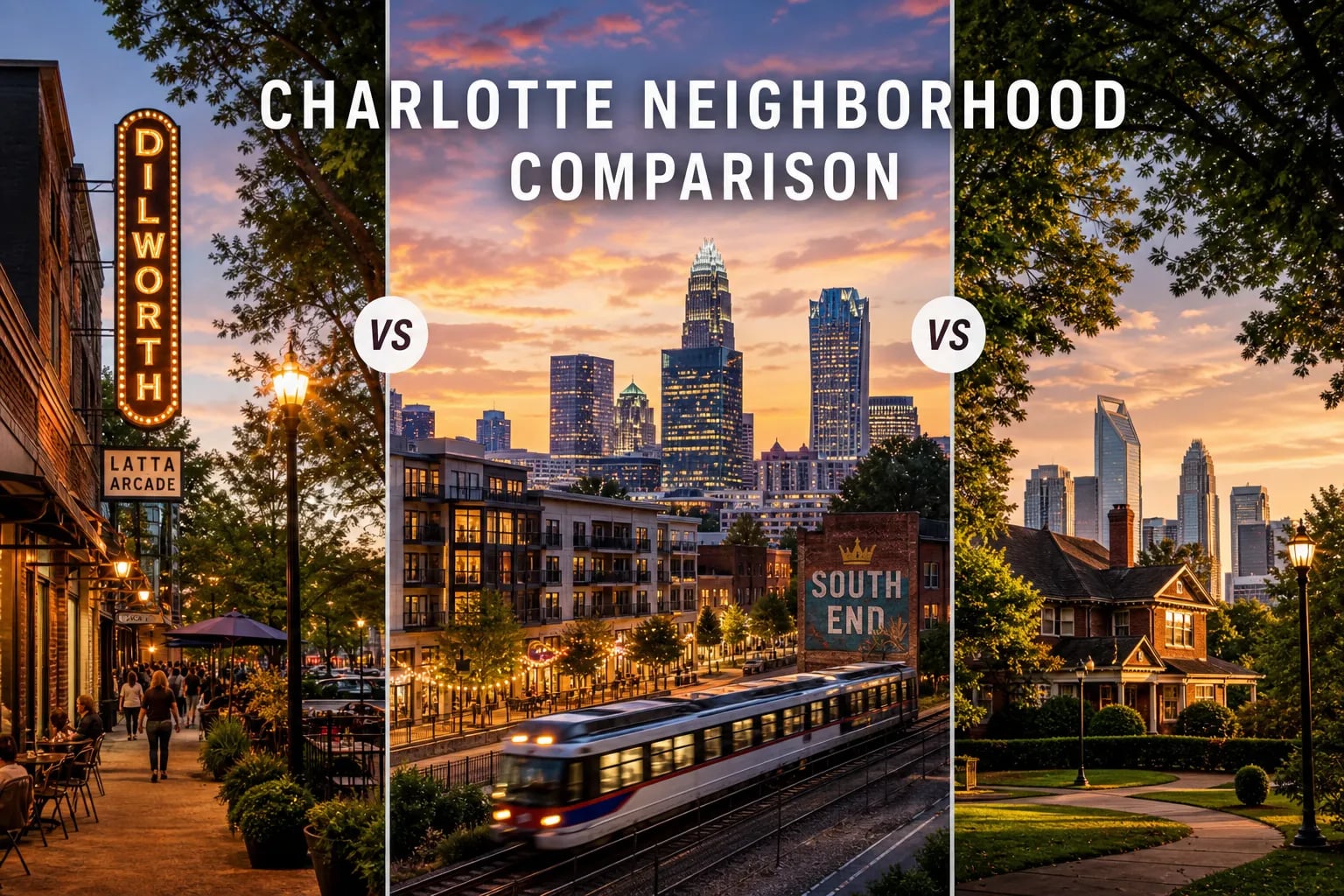
Most buyers who narrow their Charlotte search to Dilworth, South End, or Myers Park already know they want to be close to Uptown. That part of the decision is settled. What they haven’t figured out is which of these three neighborhoods actually fits the life they’re trying to build, and that’s where the real work begins. This Dilworth vs. South End vs. Myers Park Charlotte comparison will walk you through the real differences: what your money buys, how you’ll get around, where your kids go to school, and what the daily texture of each neighborhood actually feels like. All three sit roughly within three miles of the city center. All three have strong resale histories. And yet, they serve completely different buyers in ways that no map overlay or Zillow filter can surface.
Over 26 years and more than 1,500 closed transactions across Charlotte’s urban core, I’ve walked buyers through this exact decision more times than I can count. The version of this comparison you get from a real estate portal is drawn from aggregated data. What follows is drawn from the transactions themselves: the inspection surprises, the blocks that outperform their ZIP codes, HOA financial variability in South End buildings, and the Myers Park streets where sellers consistently underprice because they skipped a proper CMA. By the end of this guide, you’ll know which neighborhood fits your priorities and what your next step should be.
Dilworth vs. South End vs. Myers Park: What Your Money Buys
The 2026 median sale prices across these three neighborhoods tell a useful first story. Dilworth sits at roughly $915,000 based on August 2026 data. South End ranges from $525,000 to $681,000 depending on whether you’re looking at condos or townhomes. Myers Park comes in at approximately $1.58 million in ZIP code 28207, which covers the core of the neighborhood. Those numbers are real, but they aren’t the whole picture. Price per square foot and what’s actually inside the home tell you more.
Dilworth’s median reflects a mixed inventory: renovated Craftsman bungalows, some newer infill townhomes, and a handful of condos scattered across the neighborhood’s tree-lined grid. The range is wide because quality is wide. A well-renovated bungalow on a strong block and an infill townhome two streets over can carry meaningfully different values even when they’re priced similarly.
South End is a different product entirely. This is a condo and townhome market built around walkability and the LYNX Blue Line corridor, with heavy new construction and modern finishes. Buyers here are purchasing a lifestyle and a location more than a character home. Myers Park is its own category: large formal single-family homes on generous lots, a mix of original estates and full-gut renovations, all within a neighborhood that has held its visual and social standard for generations.
Getting Around: Walkability, Transit, and Commute to Uptown
South End’s Light Rail Advantage
South End sits directly on the LYNX Blue Line corridor, served by stops including Carson, Bland Street, and East/West Boulevard. That single fact reshapes the entire neighborhood’s appeal and its pricing. The commute to Uptown runs five to ten minutes by rail or car. For buyers who want to leave the car in the garage most weekdays and walk to a rail stop instead, South End is the only one of these three neighborhoods where that’s genuinely realistic without compromise. As of August 2026, South End carries a Walk Score of 74 and a Bike Score of 58, figures that reflect a neighborhood built around movement, not just proximity.
Dilworth vs. Myers Park: By Foot and By Car
Dilworth scores a Walk Score of 78 as of August 2026, which is high by Charlotte standards, and it earns that rating. Restaurant strips, coffee shops, Freedom Park, and daily errands are reachable on foot or bike from most blocks. Rail access is more limited than South End, primarily near the East/West Boulevard area, but most Dilworth residents drive to Uptown in seven to ten minutes. Myers Park, despite its in-town address, is the most car-dependent of the three. The streets are wide and beautiful, but destinations are spread out, and the commute to Uptown runs seven to fifteen minutes depending on which block you’re on. In this Dilworth vs. South End vs. Myers Park Charlotte comparison, walkability is a genuine lifestyle differentiator, not a secondary consideration.
Schools and What Families Need to Know Before Choosing a Block
Myers Park Schools and Historic Homes: Why the Feeder Pattern Commands a Premium
Myers Park has the clearest and most consistent public school path of the three. Many families in the neighborhood feed into Selwyn Elementary, which holds an 8/10 from GreatSchools and an A- from Niche, then move to Alexander Graham Middle and Myers Park High. Myers Park High carries an A from Niche and ranks sixth in Mecklenburg County. A predictable feeder chain at that quality level is genuinely rare in an urban Charlotte neighborhood. It explains a meaningful portion of the neighborhood’s price premium for buyers with school-age children, and it should be weighed carefully when comparing total cost of ownership against private school tuition in a neighborhood without the same assignment clarity.
Dilworth and South End School Considerations
Dilworth Elementary is well-regarded and draws buyers with young children, but school assignment in Dilworth depends more on exact street and boundary lines than it does in Myers Park. The feeder chain to middle and high school is less uniform, which means buyers need to verify assignments by their specific address before committing to a purchase. South End has the most variable picture of the three. The neighborhood is condo-dense and transit-oriented, and school assignment there relies more on Charlotte-Mecklenburg Schools’ district choice and lottery process than on a clear neighborhood zone. For families where school assignment is a top-three priority, that distinction deserves real scrutiny before settling on a neighborhood.
Neighborhood Character and What Daily Life Actually Looks Like
South End Charlotte: The City’s Most Activated Urban Neighborhood
South End is Charlotte’s most energized urban neighborhood. The light rail corridor has anchored a dense stretch of restaurants, bars, breweries, fitness studios, and boutique retail that draws residents and visitors alike. The Rail Trail gives residents a car-free path through much of the neighborhood. Buyers choosing South End are largely choosing a lifestyle: young professionals, remote workers, and couples who want to walk to dinner, catch the rail to an event Uptown, and live somewhere that feels like a city rather than a suburb-adjacent address. The energy is real, and so is the noise near the busier sections of the corridor, which matters when you’re evaluating specific buildings.
Dilworth Charlotte Neighborhood: Warmth With Genuine City Proximity
Dilworth sits comfortably between South End’s density and Myers Park’s quiet. It has a genuine neighborhood feel: front porches, long-established restaurants on East Boulevard, real tree cover, and a mix of longtime owners and younger families who want walkable streets without living in a mixed-use building. Freedom Park anchors the southern edge and functions as a true community gathering point, not just a green space on a map. Dilworth draws buyers who want character, community, and proximity to Uptown without trading away the feel of a real neighborhood.
Myers Park: Established, Quiet, and Unapologetically Residential
Myers Park doesn’t try to compete with South End on energy, and it doesn’t need to. The streets are formal, the lots are large, and the neighborhood operates at a slower pace than either of the other two. Sharon Road and SouthPark are accessible by car. Walkable dining is limited. What Myers Park offers instead is stability, privacy, mature landscaping, and a neighborhood identity that has held for generations without needing to reinvent itself around a light rail stop or a new development cycle. Buyers drawn to Myers Park are prioritizing long-term equity, top school access, and a home that stands apart from everything else in Charlotte’s urban core.
Long-Term Value and the Layer Online Data Can’t Show You
Appreciation Trends and Resale Strength
All three neighborhoods have demonstrated strong long-term value retention by Charlotte standards. Myers Park’s land scarcity and consistent buyer demand keep prices elevated and resale predictable. Dilworth benefits from limited inventory and a genuine waitlist mentality among buyers who know the neighborhood well enough to wait for the right house on the right block. South End has seen the sharpest appreciation tied to the LYNX Blue Line buildout, with condo values tracking closely to corridor expansion plans. None of these are speculative plays. All three have shown resilient price floors through recent market cycles, and all three deserve serious consideration for buyers prioritizing equity over the long haul.
What Block-Level Pattern Recognition Adds That No Portal Can Replicate
Raw price data stops being useful at a certain point, and local pattern recognition takes over. In Dilworth, two nearly identical bungalows on the same street can be priced $150,000 to $200,000 apart based on renovation quality, flood risk exposure, and which blocks are in the path of infill development, a range I’ve seen repeatedly across comparable sales in the neighborhood. In South End, condo values vary significantly by building, HOA financial health, and proximity to the noisier sections of the rail corridor. In Myers Park, certain blocks carry premiums that don’t fully appear in ZIP-level medians, and sellers who skip a proper comparative market analysis often underprice assets in ways that benefit well-advised buyers.
That kind of hyperlocal knowledge is what separates an advisor from a listing portal. Knowing which inspector to trust on a 1940s Dilworth bungalow, which South End buildings are overpriced by floor, and which Myers Park blocks are mispriced because the seller skipped a real CMA, that’s the work. I’ve been closing transactions in all three of these neighborhoods for more than 26 years, and no amount of time on a search app replicates what comes from 1,500-plus closings in the same region. At Carolina Realty Advisors, that depth of local knowledge is what we bring to every buyer conversation.
Dilworth vs. South End vs. Myers Park Charlotte: Which Neighborhood Fits You?
South End suits buyers who want walkability, transit access, and urban energy at a lower entry price, with the understanding that they’re buying a condo lifestyle in a neighborhood built for convenience and connection. Dilworth is the balanced choice: historic character, neighborhood warmth, solid school access, and in-town convenience at a mid-tier price point. Myers Park is the long-term equity play for buyers who want the best school zone, larger homes and lots, and a neighborhood identity that has never had to reinvent itself to stay relevant. Consider also that Myers Park’s top-rated schools may offset the premium when weighed against private tuition costs elsewhere.
The right choice in this Dilworth vs. South End vs. Myers Park Charlotte comparison depends entirely on what you prioritize, and those priorities deserve a real conversation, not a checklist. Every buyer who has sat across the table from me walked away with a clear answer and usually a short list of specific streets and properties worth their time. Reach out to Carolina Realty Advisors for direct, broker-level guidance on which neighborhood, which block, and which specific listings make sense for your situation in 2026.
Frequently Asked Questions
Which is best for families: Dilworth, South End, or Myers Park?
For families where public school quality and assignment predictability are top priorities, Myers Park is the strongest choice. Its feeder pattern from Selwyn Elementary through Myers Park High is consistent and well-rated. Dilworth is a solid second option with a well-regarded elementary school, though boundary lines require verification by address. South End’s school assignment process relies more heavily on Charlotte-Mecklenburg’s choice and lottery system, making it the least predictable of the three for families with school-age children.
Which neighborhood has the best walkability in this Charlotte neighborhood comparison?
South End leads on transit-oriented walkability, with direct LYNX Blue Line access and a Walk Score of 74 as of August 2026. Dilworth scores slightly higher at 78 for day-to-day pedestrian errands and has excellent bike infrastructure. Myers Park is the most car-dependent of the three despite its central location. If daily life without a car is the goal, South End is the clear answer. If walkable errands with a neighborhood feel matter more, Dilworth is the better fit.
Is South End or Dilworth better for first-time buyers?
South End typically offers the lower entry price of the two, with condos and townhomes starting well below Dilworth’s median. First-time buyers who prioritize urban lifestyle and transit access often find South End the more accessible starting point. Dilworth appeals to first-time buyers willing to stretch the budget for a single-family bungalow, more neighborhood stability, and stronger long-term resale history on detached homes. The right answer depends on your budget ceiling and lifestyle priorities.