
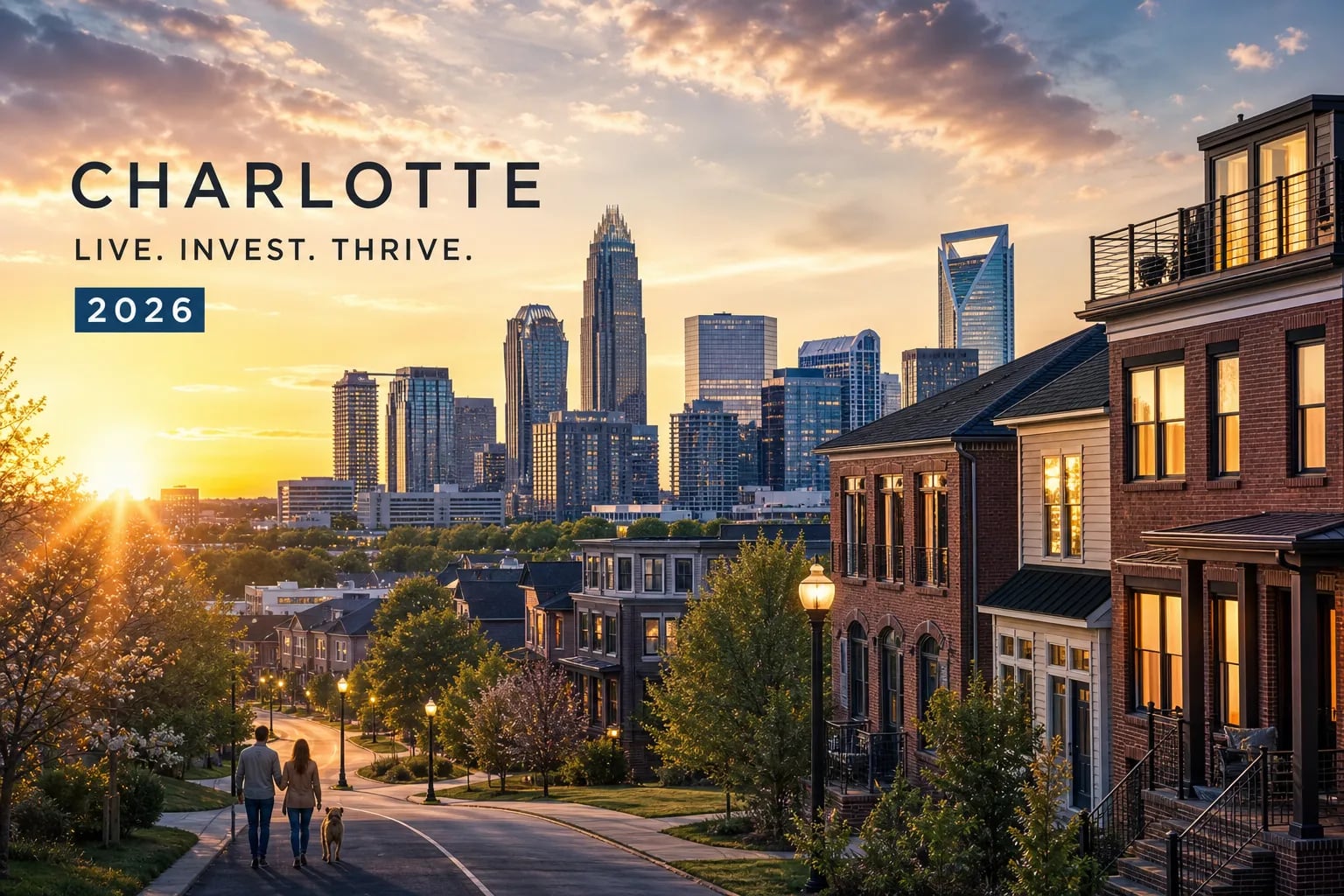
Every Charlotte homebuyer eventually hits the same wall. You’ve done your research, you’ve scrolled Zillow until midnight, and five neighborhoods all look reasonable on paper. The problem is that buying in the wrong one for your actual life means a commute that grinds you down or a price point that leaves no room for the market to work in your favor. That gap between what a neighborhood looks like online and what it delivers on the ground is where most buyers get it wrong. This Charlotte urban neighborhood guide for homebuyers exists to close that gap.
After 26 years and more than 1,500 closings concentrated in Charlotte’s urban core, the team at Carolina Realty Advisors has watched buyers land perfectly in Dilworth and struggle in South End, and vice versa. The difference is almost never price. It’s knowing what each neighborhood actually delivers once you live there. This guide breaks that down, neighborhood by neighborhood, with real 2026 numbers and the kind of pattern-level observations that only come from being on the ground in every one of these markets for decades.
Uptown Charlotte: Maximum Convenience, Compact Living
The typical Uptown buyer isn’t looking for a yard. They’re a single professional or a recent transplant who wants Charlotte’s most connected address without the friction of car dependency. Uptown carries a Walk Score of 89 and serves as the primary hub for the Lynx Blue Line and CityLYNX Gold Line streetcar, making it the city’s most transit-rich neighborhood by a meaningful margin. For the right buyer, that connectivity is worth more than square footage.
The 2026 price landscape here runs roughly $310K to $500K for most units, with the Realtor.com neighborhood median sitting near $375K. This is almost entirely a condo market. Buyers get urban density and proximity to major employers, but they trade yard space and the privacy that detached homes provide. For buyers who want low-maintenance ownership and a short commute to a downtown office, Uptown delivers a clean value proposition.
The investment picture requires more scrutiny. New residential supply is real and continuing: Trella Uptown added 353 units, the Brooklyn & Church adaptive reuse project is converting the former Duke Energy headquarters into 460 apartments, and 400 South Tryon is in development as a luxury hotel and residential conversion. That pipeline extends into 2027 and 2028. Before treating an Uptown condo as a wealth-building play, buyers need to understand HOA costs, rental competition from new inventory, and how their specific unit type positions against incoming supply.
South End: Charlotte’s Most Energetic Urban Corridor
South End is the neighborhood Charlotte shows off to out-of-towners, and that reputation is earned. Light rail access, restaurant density, craft breweries, and the Rail Trail make it a lifestyle neighborhood first. The buyer profile skews toward younger professionals and couples who want walkable nightlife and urban energy without living in a high-rise downtown. The design of South End as a neighborhood is intentional, and you feel that on the street in a way you don’t everywhere else.
What you’ll pay reflects that demand. The 2026 median sale price sits near $637K to $750K depending on the source, making South End significantly pricier than Uptown despite a Walk Score closer to 80. Buyers are paying for townhomes, newer urban single-family homes, and condos that feel like neighborhood homes rather than tower units. Most move-in-ready options cluster in the $500K to $700K range, and anything with a private yard commands a premium.
The growth trajectory here is well established, and the pipeline confirms it. The Iron District, a 55-acre mixed-use project on the former Charlotte Pipe & Foundry site, is expected to begin construction in 2026 with delivery of its first residential and retail components around 2028. Queensbridge Collective is adding its second tower to the skyline. For buyers who want strong long-term demand, South End has the signals. The nuance is evaluating how new supply affects resale timelines on specific unit types, particularly condos, where new inventory creates real competition.
Dilworth: Historic Bones, Walkable Streets, Real Neighborhood Depth
Dilworth is Charlotte’s oldest streetcar suburb, and it shows in the best possible way. Tree-lined streets, bungalows, craftsman homes, and a neighborhood grid that actually functions for walking give it a character that South End and Uptown are still building toward. The established, residential feel here is the product of decades, not a development plan, and buyers who want that kind of depth are willing to pay for it.
The 2026 median sits near $915K on Redfin’s most recent neighborhood data, with the Zillow ZHVI tracking around $768K depending on methodology. Most of the housing stock is historic single-family, with condos and townhomes appearing along the commercial edges. This is where pattern recognition matters most: blocks closest to the commercial corridors hold value differently than those farther in, and specific renovation quality separates a well-bought Dilworth home from an overpriced flip at the same price point. Knowing that difference before writing a $700K offer is exactly what experienced representation provides.
Dilworth also offers something the other urban neighborhoods on this list don’t fully match: family-grounded livability alongside urban proximity. Dilworth Elementary consistently earns strong ratings, and the neighborhood scores an A- from Niche overall. Families who want the energy of Charlotte’s urban core without sacrificing school quality tend to find their answer here rather than in Uptown or South End.
SouthPark: Suburban Polish With Serious Investment Upside
SouthPark doesn’t feel like the other neighborhoods in this guide because it occupies a different category. It’s Charlotte’s most affluent retail and commercial hub with residential neighborhoods built around it, and the lifestyle proposition is different by design. Buyers here trade walkability scores for space, newer construction options, top-tier schools, and access to one of the region’s strongest commercial corridors. The Walk Score is lower, but the tradeoff is a premium address with room to breathe.
The price range is wide. Entry points exist in the $500K to $700K range, but SouthPark trends toward $891K and above for larger single-family homes, with the ZIP-level median for 28211 supporting that figure per MLS data. The housing stock mixes older ranch-style homes on generous lots, many fully renovated, with newer construction. Renovation quality varies significantly across the neighborhood, so thorough inspection is as important here as anywhere in Charlotte’s urban market.
SouthPark posted 8.5% appreciation over the last three years, a figure worth attention for buyers thinking about resale or long-term wealth-building alongside lifestyle. That performance isn’t accidental. SouthPark’s commercial anchors and strong school district create persistent demand that holds value through market cycles. For buyers who want appreciation potential without the density of South End or Uptown, SouthPark makes a compelling case.
Myers Park: Charlotte’s Prestige Neighborhood and Why Buyers Stay
Myers Park is Charlotte’s benchmark luxury neighborhood and has been for decades. Generous lots, mature trees, and curving streets designed well before grid planning became standard give it an architectural integrity that draws buyers who are serious about their long-term address. The buyer profile is typically upsizers, executives relocating from larger markets, or long-term Charlotte residents making their final major purchase. This is where people land when they’ve decided Charlotte is home.
The Myers Park and Eastover ZIP code (28207) puts median values near $1.58M. Homes run from $1M renovation candidates to $5M estate properties, and that range reflects genuine variation in lot size, condition, and architectural pedigree. This is not a neighborhood where buyers find deals through market timing. What they find is stability and long-term value retention that few Charlotte ZIP codes can match over a 10- or 20-year hold.
Myers Park posted 15.2% appreciation over the last three years, the strongest of the five neighborhoods in this guide. For buyers thinking about the financial picture alongside the lifestyle, that track record is part of the value proposition. Resale demand in Myers Park is persistent and driven by a buyer pool deeply committed to Charlotte, which means the market here rarely gets thin even when broader conditions soften.
Charlotte Urban Neighborhood Guide for Homebuyers: Matching the Right Market to Your Priorities
Before setting a single showing, a homebuyer needs to rank their real priorities honestly. Commute first or walkability first? Family school quality or urban energy? A home that works for the next five years or one to hold for twenty? Each neighborhood in this guide scores differently across those variables, and none is objectively best.
- Uptown wins on transit access and entry price point.
- South End wins on lifestyle velocity and light rail connectivity.
- Dilworth wins on balance: character, walkability, and family livability that holds over the long term.
- SouthPark wins on appreciation, space, and school quality.
- Myers Park wins on prestige, stability, and long-term equity retention.
Three factors matter for any buyer working through this Charlotte urban neighborhood guide: the new supply pipeline (especially in Uptown and South End), the specific block within the neighborhood (particularly true in Dilworth and SouthPark), and the condition of the home relative to its price. Renovation quality is inconsistent across all five of these markets, and the gap between a well-executed renovation and a cosmetic flip can represent $100K in real value that doesn’t appear in the listing photos. These aren’t abstract concerns. They’re the kind of observations that take years of closed transactions to calibrate with confidence.
This is where having a broker who has personally represented buyers and sellers across all five neighborhoods becomes genuinely useful. Carolina Realty Advisors has been active in Charlotte’s urban core for over two decades, with 1,500+ closings spanning Uptown condos, Dilworth bungalows, South End townhomes, SouthPark single-family homes, and Myers Park estates.
That depth of local experience isn’t just reassuring. It’s the difference between knowing a neighborhood by its Zillow listing and knowing it by its closed sales, its inspection patterns, and the specific blocks that hold value versus those that don’t. No other frame of reference gets a homebuyer that close to the ground.
Charlotte’s Urban Core Rewards Buyers Who Do This Work First
Charlotte’s urban core offers five genuinely different answers to the question “where should I buy?” The right answer depends on your life, not on which neighborhood is trending on social media or generating the most interest from out-of-state buyers this quarter. Each neighborhood in this charlotte urban neighborhood guide for homebuyers serves a real buyer well, and falls short for a different one. The goal isn’t finding the “best” neighborhood. It’s finding yours.
If you’re ready to narrow from five options down to two, that conversation is worth having sooner rather than later. Reach out to Carolina Realty Advisors directly to talk through what your priorities actually look like on the ground. That first conversation costs nothing and typically saves buyers from a very expensive wrong turn.