
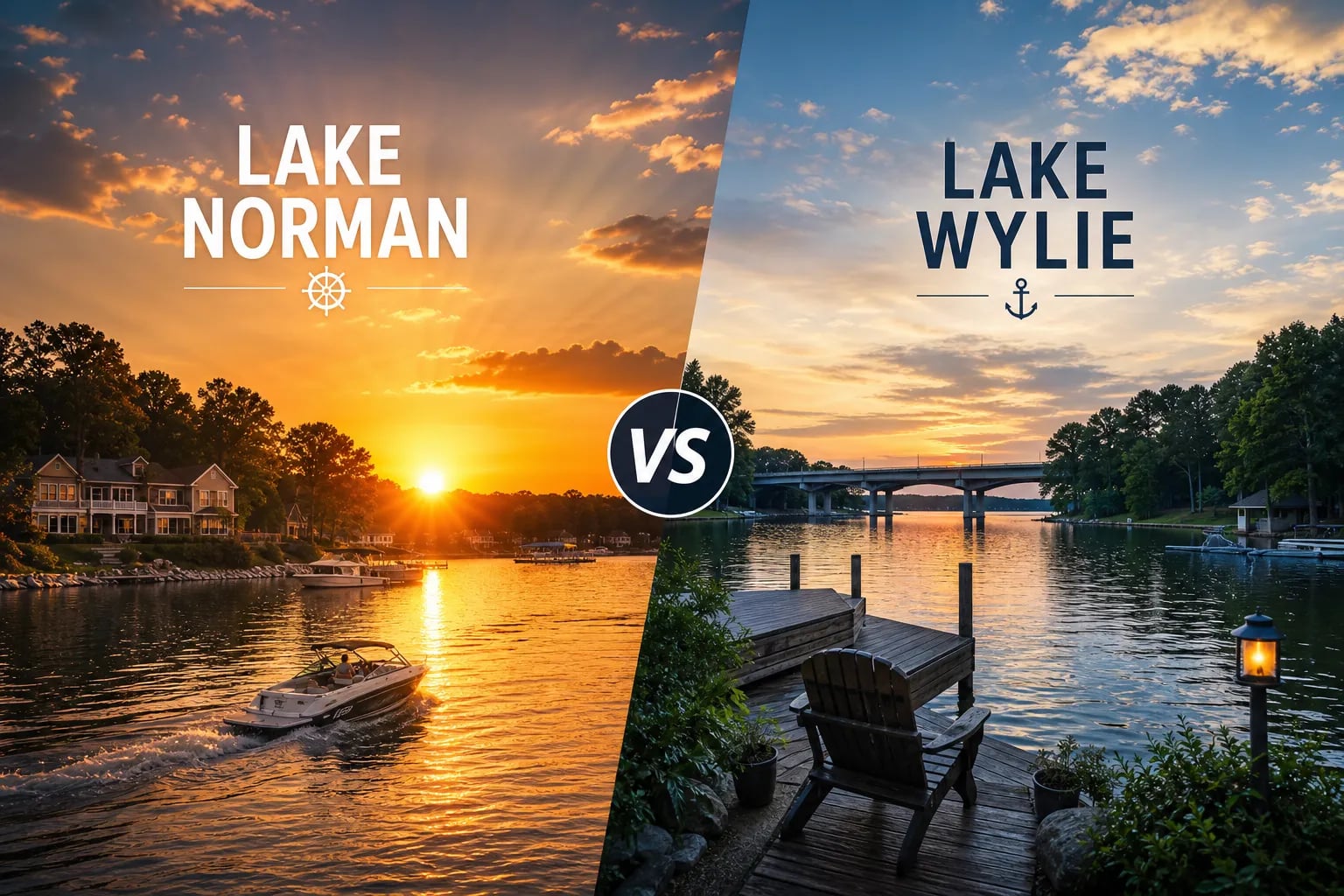
Lake Norman vs. Lake Wylie, which is better for homebuyers, is a comparison most buyers never get answered properly. Two great lakes sit within striking distance of Charlotte, one on each side of the state line, yet buyers research them separately almost every time. That’s the wrong approach. These are fundamentally different markets, and the factors that separate them (price structure, commute math, property taxes, water access rules, and rental income potential) don’t surface cleanly in a Zillow search. Most buyers end up talking to a North Carolina agent for Lake Norman and a separate South Carolina agent for the south side, which means no one is doing the real comparison for them.
This article covers the six factors that actually move buyers off the fence: home prices, lifestyle, commute, property taxes, HOA and water access rules, and short-term rental potential. Mike Sposato at Carolina Realty Advisors holds dual licensure in both North Carolina and South Carolina and has closed transactions on both lakes. That context will matter by the time you reach the end.
What Home Prices Actually Look Like on Each Lake in 2026
Lake Norman waterfront homes are carrying median sale prices in the $1.65M to $2.21M range, with price per square foot landing between $606 and $728 depending on the community and lot position. Non-waterfront homes around the northern lake run a separate conversation entirely, with a median closer to $672,000 to $737,000 and typical pricing of $250 to $300 per square foot. The waterfront premium is real and significant, driven by dock-eligible lots, established communities, and sustained demand from out-of-state relocators upsizing from Charlotte.
Waterfront vs. Non-Waterfront Prices
Lake Wylie tells a different story at the entry level. The overall market median sits around $570,000 at roughly $207 per square foot across all homes. True waterfront on the south side averages closer to $1.5 million, with a realistic range of $700,000 to $2 million depending on the lot. Non-waterfront homes on the South Carolina side of the lake, particularly in the Fort Mill and Clover corridors, frequently come in between $300,000 and $550,000. For buyers who want water proximity without a seven-figure entry point, that spread matters.
On inventory velocity, Lake Norman waterfront homes average 53 to 66 days on market with about 3.2 months of supply. Lake Wylie waterfront homes average closer to 43 days on market, with only 14 active waterfront homes under contract noted in the mid-year 2026 update. Thin waterfront inventory on the south side means less selection, but also less competition when the right property appears. Your offer strategy shifts accordingly on each lake.
Lifestyle, Communities, and What Daily Life Actually Feels Like
Lake Norman is large, 34,000 acres managed by Duke Energy, and its communities have developed real personality over decades. Davidson carries a walkable, college-town character with independent retail, weekend farmers markets, and a historic downtown. Cornelius and Huntersville sit closer to Charlotte and offer more commercial density, with restaurants, gyms, and retail corridors that feel suburban without being remote. Mooresville runs quieter and more spread out, appealing to buyers who want distance from the closer-in activity.
The boating culture on Lake Norman is central to the identity of the whole market. Marinas, sailing clubs, and organized Fourth of July events on the water define the summer calendar. Because the lake is large enough, weekday boating rarely feels congested. Weekends from Memorial Day through Labor Day are the exception, and buyers who want peace and quiet should factor that into their expectations before choosing a property with direct boat access.
Lake Wylie, at 13,400 acres, is more concentrated and noticeably quieter in character. Tega Cay, the incorporated city on the South Carolina side, is almost entirely residential, no commercial strip, no marina district, just neighborhoods and water. The communities around Clover on the South Carolina side share that same residential tone. Buyers who want lakefront living without boat-parade weekends will find the south side fits that preference better. The tradeoff is that the surrounding infrastructure is thinner than what you’d find in Cornelius or Huntersville.
Lake Norman vs. Lake Wylie: Commute Times to Charlotte
For Lake Norman, the drive to Uptown Charlotte varies meaningfully by town. Huntersville averages 27.2 minutes with driving distances of 12 to 18 miles. Cornelius runs about 25 minutes at 20 to 22 miles. Davidson comes in at a 23.3-minute mean commute time, though drive distances hit 21 to 26 miles. Mooresville sits around 24 minutes on average but covers about 31 miles of road. Those numbers reflect off-peak conditions; I-77 southbound in the morning adds 15 to 20 minutes during peak hours consistently. The Express Lanes from Mooresville to Uptown have changed the math for northern-lake buyers who commute daily and are willing to pay the toll.
Lake Wylie’s commute to Uptown Charlotte typically runs 30 to 40 minutes under normal traffic conditions, routing through York County and Gaston County roads before reaching I-77 or I-485. That’s slightly longer than the closest Lake Norman suburbs on paper. The picture shifts for buyers commuting to South End, Ballantyne, or Charlotte Douglas Airport rather than Uptown. From the South Carolina side of the lake, those destinations can actually be competitive with, or shorter than, the drive from Cornelius or Davidson. The commute comparison depends entirely on where your office is, and buyers who don’t map both drives during rush hour are making the decision blind.
Lake Norman vs. Lake Wylie: Taxes, HOA Rules, and Water Access Rights
This section reshapes more buyer decisions than interest rates do, and most agents don’t walk through it in enough detail.
Mecklenburg vs. Surrounding County Tax Rates
Lake Norman spans four North Carolina counties: Mecklenburg, Iredell, Catawba, and Lincoln. County rates per $100 of assessed value run $0.4927 in Mecklenburg, $0.5000 in Iredell, $0.4990 in Lincoln, and $0.3985 in Catawba. Municipal taxes layered on top push the Mecklenburg combined total significantly higher. Current municipal combined rates per $100 of assessed value:
- Cornelius: $0.6858
- Huntersville: $0.7202
- Davidson: $0.7687
- Charlotte: $0.7857
On a $1.5 million waterfront home, the difference between a Cornelius address and a Catawba County address is roughly $4,500 to $6,000 per year, not a rounding error. Buyers focused only on purchase price while ignoring county jurisdiction are missing a meaningful part of the monthly cost equation.
York County Tax Structure for South Carolina Buyers
Lake Wylie’s South Carolina side operates under York County’s property tax structure, which differs from North Carolina’s in a way that specifically benefits primary-residence buyers. South Carolina assesses primary residences at 4% of fair market value; second homes and investment properties are assessed at 6%. York County’s effective property tax rate for owner-occupied homes runs approximately 0.48% to 0.65%, compared to Mecklenburg County’s effective rate of around 0.80%. Based on a comparison of the county tax rates presented above, primary-residence buyers on the South Carolina side can pay roughly 30% to 50% less in annual property taxes than they would at the same purchase price in Mecklenburg County. At the same purchase price, the monthly tax line item will be lower on the south side for most primary-residence buyers.
On dock permits: both lakes are Duke Energy-managed, and both require permits through Duke’s Lake Access Permit System (LAPS). The permit must be in the property owner’s name and must correspond to the specific shoreline the home controls. An improperly permitted dock, or one still registered to a previous owner, can create a title problem at closing that’s expensive and time-consuming to untangle. HOA covenants on both lakes vary widely. Some communities prohibit short-term rentals entirely, some cap boat sizes, and some require HOA approval before any dock modification. These restrictions rarely appear in the listing description, so buyers need to pull the covenants before going under contract, not after.
Short-Term Rental Potential If Investment Income Matters to You
Lake Norman’s STR market is well-documented. Waterfront homes average nightly rates of $407 to $522 (ADR), figures drawn from platforms including AirDNA and Rabbu, with occupancy running 36% to 43% depending on the dataset. Annual revenue estimates for average performers land in the $52,000 to $76,700 range. Premium lakefront properties with docks, pools, and boat slips push to $500 to $900-plus per night during peak summer, and some luxury homes exceed that ceiling. The investor ecosystem is established, and short-term rental demand on the northern lake is proven.
The critical caveat is that many Lake Norman communities have enacted STR restrictions through HOA covenants, particularly in Cornelius and established neighborhoods like The Peninsula. A buyer assuming rental income before reading the HOA documents is making a costly assumption. Verify the covenants and the municipality’s zoning position before underwriting any deal on projected rental income.
Lake Wylie’s STR data is thinner, which is itself meaningful. The investor ecosystem is less developed, demand is unproven, but competition for that demand is also lower. On the South Carolina side, Tega Cay regulates short-term rentals strictly: rentals under 30 days require a permit, are only allowed within a designated overlay zone, and carry occupancy caps tied to bedroom count. Buyers planning to operate a short-term rental in Tega Cay need to verify the specific property’s location relative to the overlay zone before making any assumptions about rental income. Properties in unincorporated York County follow different rules, so jurisdiction matters more than lake proximity here.
Why Comparing Both Lakes Under One Broker Changes the Outcome
Most buyers who research both lakes end up working with separate agents: a Charlotte-area NC agent for Lake Norman and a Fort Mill or south-side SC agent for Lake Wylie. The result is two agents with different local knowledge, different transaction priorities, and no shared context on what the buyer actually needs. Nobody is doing a true apples-to-apples comparison on cost, lifestyle, and tax impact across both markets.
Mike Sposato at Carolina Realty Advisors holds active licensure in both North Carolina and South Carolina. That means a buyer can evaluate a Cornelius waterfront listing and a Tega Cay lakefront property in the same conversation, with the same broker handling the tax math, the dock permit check, and the HOA covenant review for both sides. There’s no translation layer between agents, and no incentive to steer toward one side of the state line over the other. With 26 years of experience and more than 1,500 closings concentrated in exactly this geography, the comparison stops being theoretical and becomes specific to your numbers and priorities.
Lake Norman vs. Lake Wylie: Which Lake Is Right for You?
Deciding between Lake Norman vs. Lake Wylie, which is better for homebuyers, ultimately comes down to your financial picture, commute reality, and lifestyle priorities. If price accessibility is your first filter, the south side offers more realistic entry points, particularly where York County’s tax structure delivers meaningful savings for primary-residence buyers. If established communities, proven STR income, and a broader selection of waterfront inventory matter more, Lake Norman’s depth of market and name recognition build a stronger case. Neither answer is universal.
The honest next step is a conversation that maps both lakes against your actual situation, not a search that treats them as separate decisions. Reach out to Mike Sposato at Carolina Realty Advisors directly. When a property on the other side of the state line enters the conversation, you won’t need to start over with a new agent.