
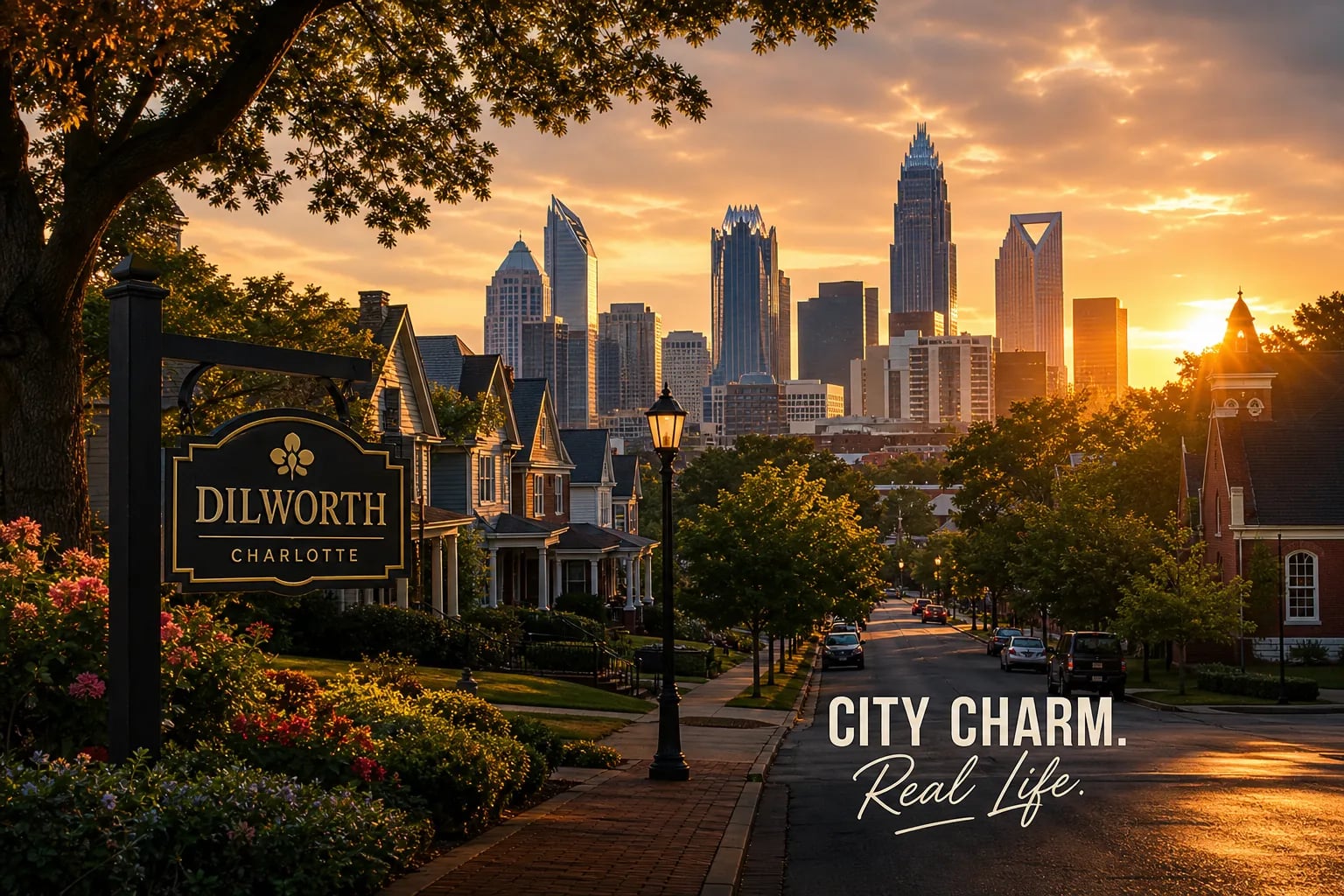
If you’re wondering what it is like to live in Dilworth Charlotte, here’s the practical answer built on 26 years of closing transactions in Charlotte’s urban core. No neighborhood generates more repeat questions from buyers than Dilworth. People have seen the photos, driven through on a Saturday morning, and fallen for the bungalows and the tree canopy. Then they come to me and ask: is it actually worth it, or is this just a well-packaged version of Charlotte nostalgia?
That is exactly the right question to ask. Dilworth has a strong reputation, and a lot of it is earned. But reputation alone doesn’t tell you whether the neighborhood fits your life, your budget, or your tolerance for older housing systems and corridor noise. What follows is the honest picture: what Dilworth feels like day-to-day, what you’re actually buying when you purchase here, what it costs, and what the resale track record looks like at the block level, everything you need to decide whether living in Dilworth NC belongs on your shortlist or someone else’s.
What It’s Like to Live in Dilworth Charlotte, Daily Life
The character that makes Dilworth different from other Charlotte neighborhoods
Dilworth is Charlotte’s oldest streetcar suburb, and that origin shapes everything about how it functions today. The streets follow a walkable grid that predates car-centric planning, lined with mature trees and early 20th-century bungalows that give the neighborhood a genuine sense of place. It sits directly south of Uptown, which means residents get proximity to the city’s energy without the density of South End condos or the noise of Uptown itself.
The vibe here is residential and rooted. People actually use their front porches. Dog walkers know each other by name. The demographic mix skews toward young professionals, dual-income couples, established families, and long-term owners who bought in a decade ago and have no interest in leaving. Dilworth is not a transitional neighborhood waiting to become something else. It has a clear identity that has held for decades, and that stability is one of the reasons buyers keep gravitating toward it.
The noise reality that listing photos won’t show you
Dilworth is not uniformly quiet, and this is the part that doesn’t come through in a weekend browse of listing photos. South Boulevard and East Boulevard are active commercial corridors. Restaurants, bars, and retail generate foot traffic and vehicle noise into the evenings, and residents near those corridors have reported early morning service noise, sometimes as early as 5:30 a.m., from trash pickup and delivery activity.
The interior blocks, the streets tucked away from the main thoroughfares, offer a substantially different experience. Quieter, more residential, and more insulated from the commercial energy that defines the corridor addresses. For buyers who are noise-sensitive, this distinction is not minor. An address on East Boulevard and an address three blocks off it are not the same product, even if they share the same neighborhood name. This is exactly the kind of thing you only learn by spending real time in the neighborhood, not scrolling listings on a Sunday afternoon.
The housing stock: what you’re actually buying in Dilworth
Bungalows, cottages, and the renovation question
The dominant housing type in Dilworth is the Craftsman bungalow, built primarily between the 1910s and 1930s, alongside cottage-style homes and a smaller share of infill townhomes and new construction. The historic stock has undeniable charm, but charm and condition are two different things. In a neighborhood where homes routinely change hands above $700,000, buyers need to think clearly about what “renovated” actually means in an older home.
A thoughtfully renovated 1920s bungalow where the electrical panel, plumbing, foundation, and crawlspace have all been addressed is a fundamentally different asset than a cosmetically updated property where the systems haven’t been touched since the Eisenhower administration. The most common inspection findings in Dilworth’s bungalow stock are worth knowing before you fall in love with a listing:
- Knob-and-tube or undersized electrical wiring
- Corroded cast-iron or galvanized plumbing
- Crawlspace moisture and wood rot
- Foundation settling tied to clay soil
- Deferred maintenance on wood windows, porch columns, and exterior trim
Before you fall for the heart pine floors and original millwork, ask your inspector and your broker specifically what was updated versus what was painted and staged.
New construction and townhome product in the neighborhood
Infill development has added new townhomes and small-footprint new builds throughout Dilworth over the past decade. These properties offer modern systems, lower near-term maintenance costs, and better energy efficiency than the historic stock. The trade-off is architectural character: most infill construction does not match the streetscape quality of the original bungalows, and it often breaks the visual continuity of the blocks where it sits.
Price points for new construction and recent townhomes sit at the upper end of the Dilworth range. Buyers who prioritize historic character and resale performance in the bungalow market are playing a different long-term game than buyers drawn to new construction convenience. The two product types don’t always behave the same way when it’s time to sell, and that distinction matters if you’re thinking about this purchase as a medium-to-long-term investment.
What It Costs to Live in Dilworth Charlotte (2026)
Home prices and the range buyers should expect
Dilworth is not an entry-level Charlotte neighborhood. Current market data puts the median home price in the $699,000 to $915,000 range depending on the source and sales window. The Dilworth Historic District commands a notably higher premium, with median list prices reported around $1.41 million in recent market snapshots. Buyers competing for well-priced product on the interior blocks in the $700K to $800K range should expect limited inventory and relatively fast movement when quality homes are priced correctly.
Rental options exist and provide a practical way to experience the Dilworth lifestyle before committing to purchase. One-bedroom units run approximately $1,720 per month, and two-bedrooms land around $2,200 to $2,260 per month for most product types. Interior-block rentals are harder to find and move faster than corridor-adjacent units, so renters who want the quieter residential experience should move quickly when those options appear.
Who this price point is realistic for
Based on the figures above, buyers in the $700,000 to $800,000 range need meaningful down payment capital and a household income that supports the payment without financial strain. Dilworth is not realistically priced for first-time buyers without family equity, a significant savings base, or both. The buyers who thrive here are typically dual-income professionals, equity-rich move-up buyers from other Charlotte neighborhoods, or relocating professionals whose compensation supports the price point.
That’s not a judgment on anyone’s situation. It’s the honest market reality, stated plainly, so you can self-qualify before you spend three weekends touring Dilworth homes for sale in a neighborhood that doesn’t fit your current financial position. Falling in love with a neighborhood and then discovering the numbers don’t work is a painful way to spend your time.
Walkability and daily life in Dilworth
East Boulevard and what’s reachable on foot
Dilworth earns its Walk Score of 78 (Very Walkable) legitimately. East Boulevard is the neighborhood’s spine: coffee shops, restaurants, the Dilworth Tasting Room, and everyday services are all within easy walking distance for most residents. Latta Park sits inside the neighborhood, and Freedom Park is minutes away on foot. For most Dilworth addresses, car-free weekends are practical rather than aspirational.
Grocery access is reasonable, and the concentration of dining and café options is demonstrably strong compared to other Charlotte neighborhoods at similar price points. This is one of Dilworth’s clearest competitive advantages. Dog owners especially benefit from the park access and the pedestrian-friendly grid, which makes the neighborhood one of the better choices in Charlotte for households where a dog shapes how you actually use your home and your surroundings every day.
Getting to Uptown and the commute reality
By car, Uptown Charlotte is 5 to 10 minutes from most Dilworth addresses, not a commute that registers as a daily stress point for most people. CATS bus service runs along East Boulevard for transit users, and the LYNX Blue Line in adjacent South End is accessible by foot or a short drive for those who prefer rail. The Charlotte Rail Trail also connects residents to the broader greenway network, making biking or walking to work a real option for some commuters, not just an aspirational one.
For remote workers or hybrid commuters, Dilworth’s location is close to ideal. You’re close enough to make occasional office days easy, but you’re living in a residential neighborhood rather than in the middle of the density and noise that comes with Uptown or South End proper. That balance is one of Charlotte’s clearest advantages in this price tier, and Dilworth is where you find it most consistently.
Safety, schools, and who Dilworth actually fits
The real safety picture in Dilworth
Overall crime in Dilworth tracks close to the Charlotte city average, and the primary resident concern is property crime: theft, vehicle break-ins, and burglary rather than violent crime. CrimeGrade data identifies the northeast section of Dilworth as the safest part of the neighborhood, while the southern edges and the areas adjacent to the commercial corridors on South Boulevard show higher reported incident rates.
The practical takeaway is to evaluate the specific address, not just the neighborhood name. Dilworth is not monolithic from a safety standpoint, and the difference between blocks matters. The neighborhood’s boundaries span notably different environments from one end to the other, which is exactly why block-level knowledge, not zip-code generalizations, should drive your decision.
Schools and which households Dilworth suits best
Dilworth Elementary Latta Campus is the standout in the public school picture, ranking in the top 3% of North Carolina elementary schools by some metrics and consistently cited as one of the better public elementary options in Charlotte. Sedgefield Middle and Myers Park High School round out the public school options for families with older children. For private school options, St. Patrick Catholic School, Kent Academy, and Epiphany School of Charlotte are all nearby. Families relocating with school-age children should verify current enrollment boundaries with Charlotte-Mecklenburg Schools directly, since those boundaries have shifted over time.
Dilworth suits a wide range of household types beyond just families. Singles and couples without children benefit from the walkability and the proximity to dining and nightlife. Dog owners use the parks heavily and find the neighborhood’s pedestrian-friendly layout practical for daily life. The neighborhood has a clear identity that works for multiple life stages, which is part of why resale demand stays consistent here even as buyer demographics shift over time.
Resale trends and the blocks that perform better than others
Why Dilworth holds value and where
Dilworth has consistently outperformed many Charlotte neighborhoods on resale because its core advantages are permanent: location relative to Uptown, a walkable grid that can’t be replicated in newer developments, and a historic character that appreciates in value as more buyers prioritize those qualities. The neighborhood doesn’t carry the resale volatility of newer master-planned communities, because the land scarcity and the architectural identity are already established. Myers Park commands higher absolute prices, and South End has grown from a lower base, but Dilworth’s combination of accessibility and character keeps its demand floor strong.
Not all Dilworth addresses perform equally at resale, though. Interior blocks with mature tree canopy, intact historic architecture, and distance from the commercial corridors consistently outperform corridor-adjacent properties and streets where infill new construction has broken the streetscape continuity. Days on market in the tightest parts of the historic district can be extremely short, while broader neighborhood averages in 2026 run closer to 53 to 60 days. The spread between those two experiences is significant, and it reinforces why block-level knowledge matters.
Why advisory-level representation matters in a neighborhood like this
At Carolina Realty Advisors, we have closed enough transactions in Dilworth to know which specific streets carry the strongest resale performance, which inspection findings are legitimate negotiation points versus deal-killers in older bungalow stock, and where the noise-to-value trade-off tips the wrong direction. Knowing the difference between a foundation crack that’s cosmetic settling and one that requires structural intervention is not something you develop from a weekend of touring open houses.
A buyer who visits Dilworth on a Saturday afternoon sees the best version of the neighborhood: the light through the trees, the families on the porches, the coffee shop that always has a line. An experienced local broker shows you the full picture, which addresses outperform at resale, which listings have sat longer than average for reasons that don’t appear in the listing description, and what to ask the inspector before you write an offer on a 1925 bungalow. That is the difference between buying a home and making a sound real estate decision.
The bottom line on Dilworth
For buyers and renters who value walkability, neighborhood character, proximity to Uptown, and an area with real resale staying power, Dilworth delivers on its reputation. The trade-offs are real: the price point is not accessible to everyone, corridor noise is a legitimate quality-of-life consideration for the wrong addresses, and older housing systems require honest scrutiny during inspection. None of those are dealbreakers, but they deserve to be weighed honestly rather than glossed over because the neighborhood photographs beautifully.
If you want a direct answer to what it is like to live in Dilworth Charlotte, you can’t get it from a listing portal. It’s walking the interior blocks on a weekday evening, not just a Saturday morning. It’s talking to a broker who works this neighborhood regularly and can answer questions about specific streets, not just the zip code. And it’s getting real answers about the property you’re considering before you fall in love with a listing and start rationalizing the things that should be giving you pause.
Reach out to our team at Carolina Realty Advisors when you’re ready to have that conversation. We work this neighborhood personally, and we’ll give you the same honest assessment in person that you just read here.